








Plectis

I’m Will Cook. I use AI to research Erdős problems, questions posed by the mathematician Paul Erdős, and I build tools that help people follow what AI produces.

Videos

  1. From INTRODUCTION: Using AI for maths research and software: See the code

  2. From INTRODUCTION: Using AI for maths research and software: Explore my research

  3. From INTRODUCTION: Using AI for maths research and software: Read OpenAI’s results

  4. From INTRODUCTION: Using AI for maths research and software: Guide the agents

About each project and video

The sibling site

Plectis Atlas

Two reports can give a paper different labels because they assess different claims. In Plectis Atlas, you can open the paper, the statement chosen for computer checking and each group’s explanation of its verdict. Atlas is independent of OpenAI.

Open Plectis AtlasSource on GitHub

Eight Erdős problem programmes

Each page gives the original question, the results checked in the Lean proof assistant, the approaches that failed and what remains unproved.

  1. #68The factorial-denominator seriesOpen
  2. #243Reciprocal-tail rigidity near the Sylvester recurrenceOpen
  3. #249The binary totient seriesOpen
  4. #251The prime-gap dyadic seriesOpen
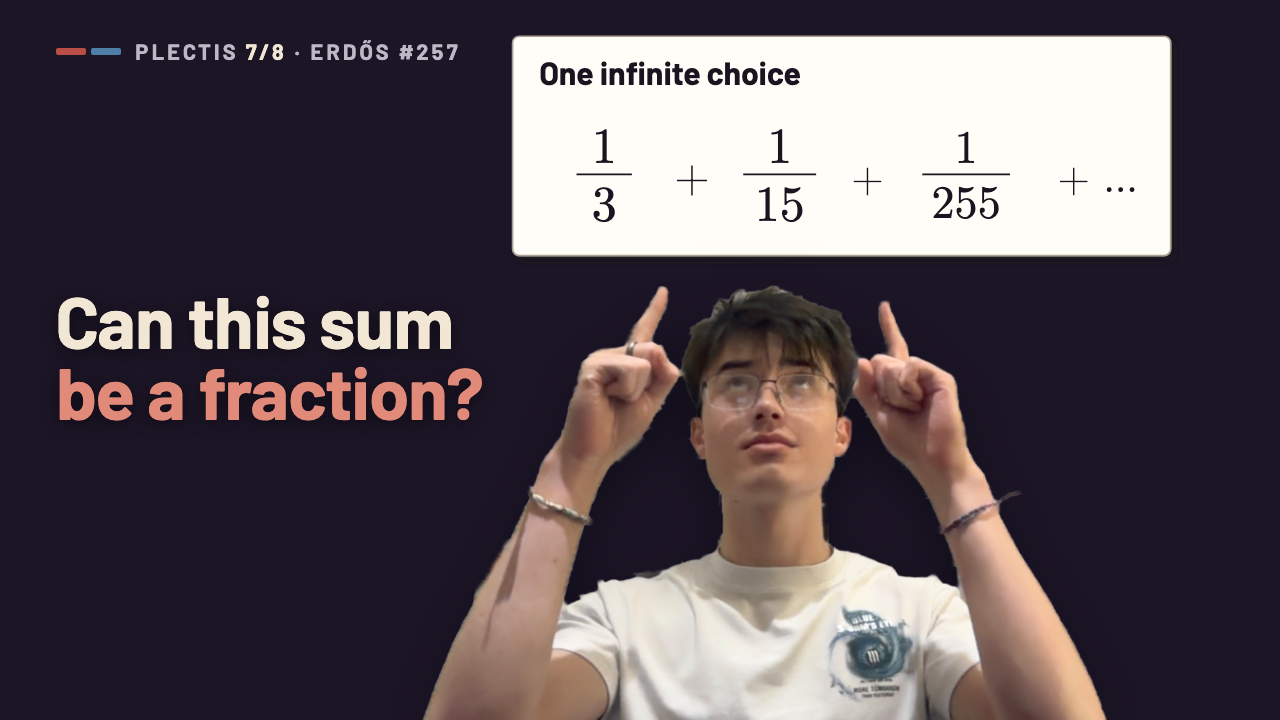
  5. #257Reciprocal sums over infinite exponent supportsOpen
  6. #269Three-prime running least common multiplesOpen
  7. #1041Short connections inside polynomial lemniscatesFormal statement refuted
  8. #1049Lambert-type series at rational basesOpen

“Open” means the Erdős problem itself is unsolved. “Formal statement refuted” means Lean disproves the exact Formal Conjectures statement; whether it matches the historical wording needs separate human review.

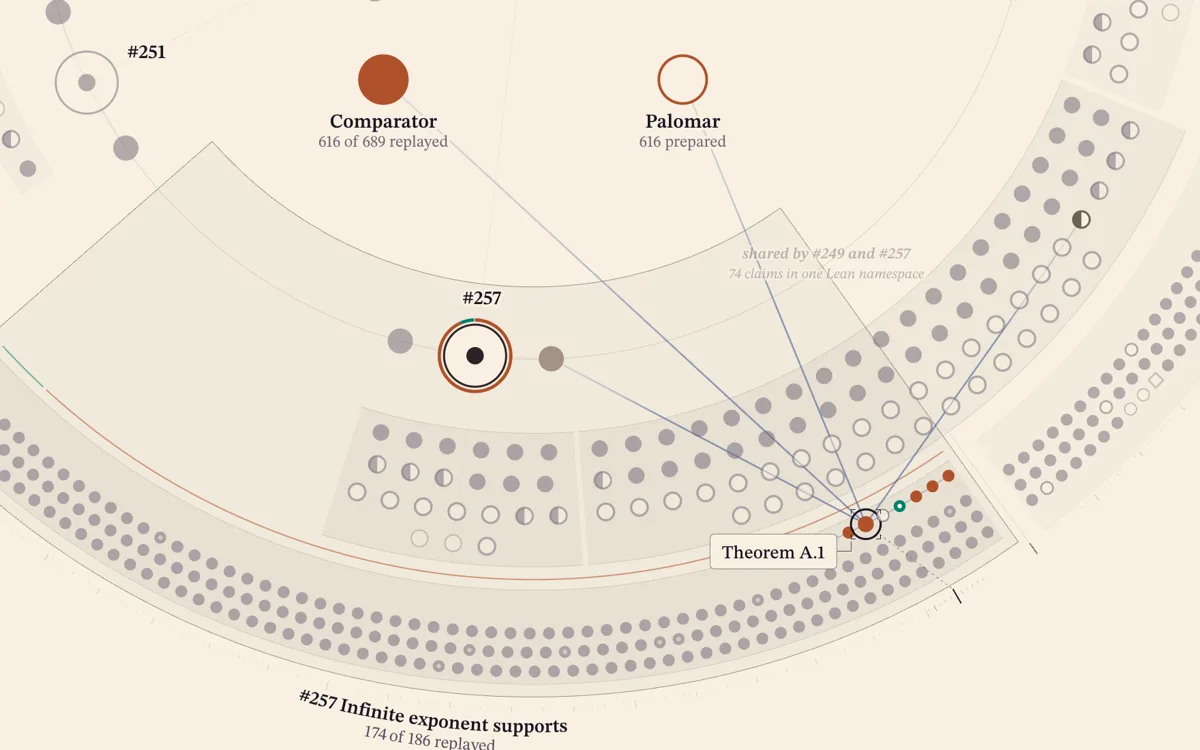
Each dot is a result stated in one of the papers; red ones have a Lean proof re-checked by a separate program.

Lean source

The map of the system draws here when its script runs. The list beside it gives the same families as text, and the full map opens every component.

Why I’m building this

As AI produces more complicated code and research, following its work gets harder. I’m using AI to build explanations and interfaces that help people inspect that work.

I keep the research, papers, code and recordings together in my working system. An agent writing a short paper can read the long research record, and a coding agent can read the same saved file descriptions that I see in Code Map.

AI does much of the research and coding. I direct the work, record the explanations and review the results. When an agent edits a video, it can read my transcript alongside the papers and code. I’d like to develop this with researchers and lecturers who can judge the subject properly.

These videos show what I’ve learned to build. I’d love to put those skills to use on other problems. I’m looking for work, an internship, fellowship or funding, and I’m very open to working together. If there’s a problem you think I should try, please let me know.

One result from Erdős #257, four ways to read it

If something doesn’t make sense, or you spot a mistake, please let me know. If your feedback leads to a change, I’d be happy to credit you, with your permission.

The eight problems

The examples below introduce each question. For a selected result, you can open its assumptions, proof files and the saved test of the proof against a separately supplied statement.

1 / 8
  1. Erdős #1041Answered: no (ani, September 2026)

    The question. Put n≥2 roots strictly inside the circle of radius 1 about 0, and form f(z)=(z−z1)⋯(z−zn). This is monic: its leading coefficient is 1. At a point z, |f(z)| is the product of its distances to the roots. Call a point allowed when that product is less than 1.

    Any two roots are less than 2 apart in a straight line. The question is whether some pair can always be joined in under 2 while staying entirely on allowed ground.

    Let f(z)=∏i=1n(z−zi)∈C[z] with |zi|<1 for all i. Must there always exist a path of length less than 2 in {z:|f(z)|<1} which connects two of the roots of f?

    A complex number z=x+iy is a point (x,y) in the plane. Its modulus |z|=x2+y2 is its distance from 0; |z−w| is the distance from z to w. Multiplication multiplies moduli, so

    |f(z)|=|z−z1|⋯|z−zn|.

    The allowed region is therefore specified entirely by the roots: multiply the distances to all of them and ask whether the answer is below 1. Every root is allowed, since one factor is zero. The leading coefficient must be 1; multiplying the polynomial by a large constant would change the region.

    A path is a continuous curve, and its length counts the whole distance travelled. The straight distance between any two roots satisfies |zi−zj|≤|zi|+|zj|<2. The issue is containment: a short straight segment may cross forbidden ground. The question asks for at least one suitable pair, for every permitted polynomial. Two occurrences of a repeated root give a constant path of length zero, so a counterexample must have distinct roots.

    ani’s fixed degree-seven polynomial answers this precise question no. The paper proves the stronger statement that every connected subset of its allowed region containing two roots has one-dimensional Hausdorff measure greater than 2. This measure counts length of a set without choosing a route through it; a path’s travelled length is at least the measure of its image.

    Erdős, Herzog and Piranian posed the historical question in 1958, and Pendyala proved the degree-four case. ani posted this counterexample in September 2026. The supplied Lean sources verify the stated total-variation and Hausdorff-measure formulations. Independent human review of their correspondence with the 1958 wording is not recorded. The proof fixes one polynomial; ani’s wider small-parameter family is not proved here.

    An example. For f(z)=z2−0.81, the roots are −0.9 and 0.9. Between them, |f(x)|=0.81−x2≤0.81<1. Their whole straight segment is therefore allowed, and its length is 1.8. This polynomial answers yes; the question asks whether every permitted polynomial has such a path.

    For f(z)=z2−0.81, a path between the real roots −0.9 and 0.9 must cross the imaginary axis: its horizontal coordinate changes continuously from negative to positive. On that axis write the crossing point as iy. Then

    f(iy)=−y2−0.81,|f(iy)|=y2+0.81.

    Thus the only allowed crossings have y2<0.19, or |y|<0.436…. This vertical interval is a passage that every allowed root-to-root path must cross.

    Reaching a crossing iy from either root costs at least the straight distance 0.81+y2. Hence the whole path has length at least 20.81+y2. At y=0 this is 2×0.9=1.8, and the horizontal segment achieves that length while staying allowed.

    Moving the roots closer to the unit circle makes the passage narrower, but the horizontal segment still works. A narrow passage alone is therefore insufficient for a counterexample. The seven-root construction also puts its passage where reaching it from the two roots already costs more than 2.

    Erdős #1041. Left: the unit circle, dashed, and the region where ani's degree-seven polynomial has modulus less than 1: seven hatched petals meeting near the centre, one root in each. The roots A and B and their petals are red; the dashed chord between A and B is 1.95 long and leaves the region. Right: the centre magnified, the disc of radius 1.3 times 10 to the minus 12. Only the arms of A and B reach it, and they join at the passage P, 0.82 times 10 to the minus 12 above the centre 0. Red lines leave P towards A and B: every path from A to B passes P, and the distances from A and B to P add up to more than 2. Dashed lines leave 0 towards A and B: the distances to the centre add up to just under 2, but the line towards A crosses empty ground, where the modulus exceeds 1, so that route leaves the region. 1.95 A B 2 A B 0 P 0.82 × 10⁻¹² |f| > 1 |f| < 1 |z| < 1.3 × 10⁻¹² |A − P| + |P − B| > 2 |A − 0| + |0 − B| = 2 − 2 × 10−96

    Reading the diagram. The hatched petals are allowed ground in ani’s seven-root counterexample; blank ground is forbidden. Only the red roots A and B lie in the same connected piece. Their dashed straight segment is 1.95 long but leaves the hatching.

    The right-hand circle magnifies the centre. The red passage P lies slightly above 0: every allowed A-to-B path must pass extremely close to P. That tiny detour makes every such path longer than 2. The result below explains the length bound.

    The drawing uses two scales because the roots are about one unit from 0 while the passage is only about a trillionth of a unit away. Hatching always means allowed points, and red always marks the two arms containing A and B.

    1. Start with seven petals. The polynomial z7−1 has seven roots evenly spaced on the unit circle. Its allowed region has seven petals whose boundaries touch at 0; 0 itself is forbidden. ani changes its coefficients slightly and moves every root to distance ρ=1−10−96 from 0, strictly inside the circle. These changes are invisible in the left view but alter how the petals meet.
    2. Find the only pair that can be joined. The paper verifies that five connected pieces contain one root each and the sixth contains A and B. Paths cannot jump between pieces, so only this pair needs a length estimate.
    3. Locate every possible crossing. On the two-root piece, each ordinary polynomial value has two preimages. Cutting the disc of values along a suitable segment separates these into a side containing A and a side containing B. Any joining path must cross the preimage of the cut. A local quadratic estimate places that whole passage within ρε/3750 of P, where ε=10−12. Enclosing the whole passage rules out an alternative crossing farther away.
    4. Pay for reaching the passage. The paper’s root enclosures give |A−P|+|B−P|>ρ(2+0.143ε). Moving the crossing away from P can reduce each distance by at most the passage’s enclosing radius. Therefore every allowed joining path has length greater than ρ(2+(0.143−2/3750)ε)>2. The excess is tiny but strictly positive.

    The dashed route through 0 would cost |A|+|B|=2ρ<2, but part of it crosses blank ground. The close-up shows why moving from 0 to the compulsory passage matters. Its contours approximate the region at drawing precision; exact rational inequalities in the paper establish the bound. The result panel below replaces the tiny passage by a larger enclosing disc so that this same length obstruction is visible.

    The interesting resultCounterexample

    A polynomial for which every connecting path is too long

    The region where ani's degree-seven polynomial has modulus below 1: seven hatched petals inside the unit circle, one zero in each, with the zeros A and B in red, 1.95 apart, joined by red legs through the centre, and the dashed ellipse on which the distances to A and B add up to 2, passing through the centre. Beside it, the disc of radius 1.2 times 10 to the minus 12 about the centre: the arms of A and B meet at a passage just beyond the ellipse, now a dashed line; a small red circle C encloses the passage, and red rays leave it towards A and B. Reaching C from A and from B costs more than 2, so every path joining two zeros is longer than 2. 2 1.95 A B |z| < 4.4 × 10⁻¹² 0 < 2 > 2 C > 2 |z| < 1.2 × 10⁻¹² ws dist(A, C) + dist(B, C) > 2 C: |w − 4i/5| ≤ 1/10

    Select a paragraph to show its step in the drawing.ani’s degree-seven polynomial has seven distinct roots strictly inside the unit circle, yet no pair has an allowed joining path of length at most 2. The dots are roots; the hatching is allowed ground, where |f(z)|<1 (the product of distances to the roots). A connected piece is one that can be traversed without leaving allowed ground. Only the red roots A and B share a piece. They are 1.95 apart; the close-up shows where their two red arms join.Try the red broken line through the centre 0: its two legs total just under 2. More generally, visiting any point z costs at least |A−z|+|z−B|, the two straight distances to it. The dashed ellipse is the set of points where |A−z|+|z−B|=2. A path of length at most 2 must stay inside this boundary. The close-up magnifies it until it looks straight. Every allowed A-to-B path must cross the tiny passage inside the red disc C. The entire disc lies beyond the dashed boundary. C encloses the passage; it is deliberately wider than the passage itself. The distance from A to C plus the distance from B to C already exceeds 2. Even free travel inside C cannot fit the budget. The short route through 0 fails because it leaves allowed ground.

    Theorem 1.2 proves the stronger claim that every connected subset of the allowed region containing two roots has one-dimensional Hausdorff measure greater than 2. This measures the length of a set, independently of a path tracing it, and is at most the travelled length of such a path. Five connected components contain one root each; only the sixth contains A and B. Write these roots as A=ρζ3, B=ρζ6, with |ζj|=1, ρ=1−10−96 and ε=10−12.

    Why must a path reach C? On the two-root component, each ordinary value in the unit disc has two preimages. Cutting that value disc from its unique critical value to the boundary separates the preimages into two open regions, one containing each root. A joining path must cross the preimage of the cut. The paper’s Lemma 2.1 confines this whole passage within ρε/3750 of the critical point cs=ρεws, where |ws−4i/5|<1/40. Consequently it is enclosed by the drawn disc C={z:|z−c|≤ρε/10}, centred at c=(4/5)iρε.

    The verified root enclosures imply Im⁡(ζ3+ζ6)<−1/3. Projecting the two root-to-centre vectors onto their respective root directions gives |A−c|+|B−c|>ρ(2+4ε/15). Subtracting the two disc radii yields dist⁡(A,C)+dist⁡(B,C)>ρ(2+ε/15)>2. For a connected set, radial projection on each of the two disjoint open regions gives the corresponding measure bound; those contributions can be added. The contours in the close-up approximate the allowed region; the inequalities, rather than the plotted pixels, prove the obstruction.

    The supplied Lean sources cover arbitrary preconnected sets, the negation of the Formal Conjectures statement, and path total variation. This is one fixed polynomial: ani’s small-parameter family is not proved here. Independent human review of the match with the original 1958 wording is not recorded. This drawing supplies no new Lean replay.

    There is a monic polynomial f of degree seven with all its zeros in the open unit disc such that every continuous path in {z:|f(z)|<1} joining two distinct zeros has an image of one-dimensional Hausdorff measure at least 2. This measures the set traced by the path, without counting repeated visits; for a rectifiable path it is at most the path’s length. The witness is ani’s polynomial.

    Proof idea. Five components of the allowed region each contain one zero. Only the sixth contains a pair, labelled A,B. The paper traps the passage between them in a tiny disc C. Reaching that disc from both zeros already costs more than 2: dist⁡(A,C)+dist⁡(B,C)>2. A projection argument turns this distance bound into a Hausdorff-measure bound for a connected set joining the zeros. The magnified picture illustrates the geometry; exact estimates establish the bound.

    Boundary. The linked Comparator receipt checks the Formal Conjectures negation, expressed using Hausdorff measure of path images, and separately checks ani’s degree-seven counterexample in the total-variation formulation. The paper also proves a stronger connected-set statement; that printed formulation has a separate verification record. The example, which ani posted on the erdosproblems.com forum on 7 September 2026, answers the question as erdosproblems.com and Formal Conjectures state it; correspondence with Erdős’s original 1958 wording has not received independent human review.

    Lean proofComparator checkPaper §2In the map

    Lean is a programming language for mathematics: a theorem is written in it and a computer checks every step of its proof. Comparator is a separate checking tool: it tests the Lean proof against a statement of the theorem written down on its own, so a proof of a weaker or different statement would fail.

  2. Erdős #257Open

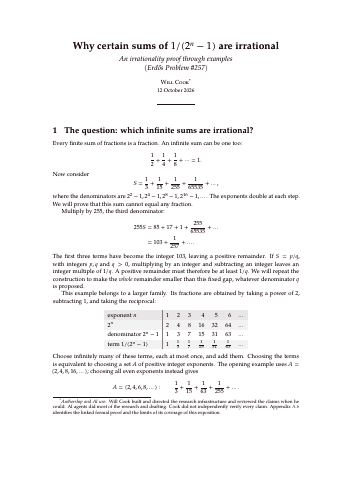
    The question. The powers of 2, minus 1, are 1,3,7,15,31,…. Take their reciprocals and choose infinitely many, without repetition. Write A for the chosen positive exponents and X=∑n∈A1/(2n−1) for the sum. Every choice converges. Must its value always be irrational, meaning unequal to every ratio of integers?

    Let A⊆N be an infinite set. Is ∑n∈A12n−1 irrational?

    The exponent n starts at 1: exponent 0 would give a zero denominator. For every positive n, 2n−1≥2n−1, so

    0<X≤∑n≥121−n=2.

    Thus convergence is automatic, even before a choice of exponents is made. The issue is rationality of the limit. Finite selections always have rational sums; for example, 1/3+1/7=10/21. Rational partial sums can nevertheless have an irrational limit, so checking finitely many terms cannot decide the question.

    All denominators 2n−1 are odd. Consequently, every finite selection has an odd denominator when reduced to lowest terms. This restriction need not survive an infinite limit: whether an infinite selection sums to 1/2 is itself still unknown.

    An example. The diagram uses exponents made by multiplying 2s and 3s: A={1,2,3,4,6,8,9,12,…}. Its sum begins X=1+1/3+1/7+1/15+1/63+⋯. This case is known to be irrational: the criterion ∑n∈A1/n<∞ applies, with reciprocal exponent sum 3. The unrestricted problem imposes no such condition.

    The displayed exponents are exactly A={2i3j:i,j≥0}. Their reciprocal exponent sum is

    ∑i,j≥02−i3−j=(1+1/2+1/4+⋯)(1+1/3+1/9+⋯)=3.

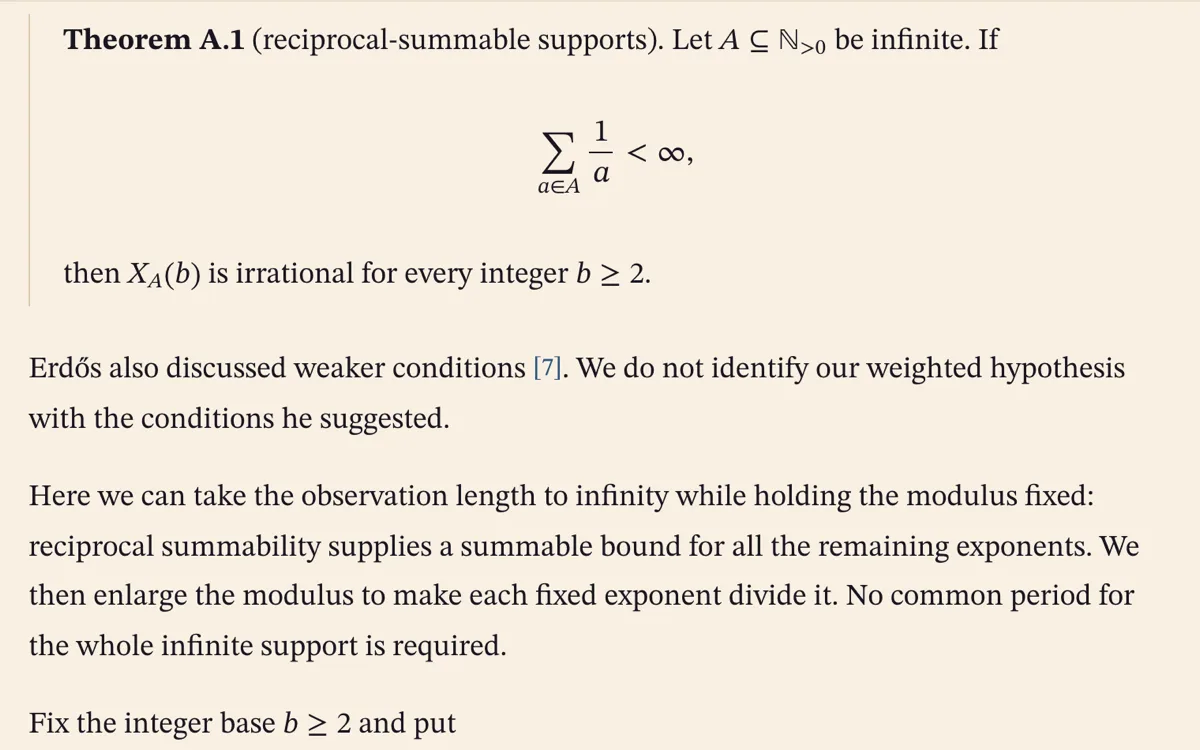
    Erdős stated that finite reciprocal exponent sum suffices for irrationality; Appendix A of the short paper supplies a proof. This is a sufficient condition, not a condition required by the problem.

    To read a row, the binary places from left to right have values 1/2,1/4,1/8,…. A dot means that place is included. The geometric-series identity

    12n−1=2−n+2−2n+2−3n+⋯

    puts dots at every nth place. Each row continues forever; only 24 places and the exponents at most 24 are drawn. The rows represent separate summands, rather than the binary digits of their total.

    Multiplication by 212 shifts the binary point 12 places. Subtracting the original row cancels its fractional part exactly when its period divides 12. For row 3, (212−1)/7=585 is an integer. For row 8, (212−1)/255=16+1/17, so the remainder is 1/17=0.0588…, as printed. The final line includes all omitted rows.

    Erdős #257. Rows of dots for the numbers n = 2 to the i times 3 to the j up to 24 (1, 2, 3, 4, 6, 8, 9, 12, 16, 18, 24, then 27, 32 and so on): row n is 1 over 2 to the n minus 1 in binary, a dot at every n-th place after the point, over places 1 to 24. A cut after place 12 marks N = 12. The rows of 1, 2, 3, 4, 6 and 12, in red, divide 12 and repeat exactly after the cut, so each leaves 0; the other rows, in blue, do not repeat and leave 0.0588, 0.0137, 0.0625, 0.0156 and 0.000244, and the members from 27 on leave 0.0000315. The leftover at N = 12 totals 0.1509; over every n it would be 1.416. … … … … … … … … … … … N = 12 1 2 3 4 5 6 7 8 9 10 11 12 13 14 15 16 17 18 19 20 21 22 23 24 binary place k 1 2 3 4 6 8 9 12 16 18 24 n 27, 32, … leftover 0 0 0 0 0 0.0588 0.0137 0 0.0625 0.0156 0.000244 0.0000315 total 0.1509… every n 1.416… rows: n = 2i3j, up to 24

    Reading the diagram. Each row represents one reciprocal in binary: row 3 has a dot at every third binary place, since 1/7=1/8+1/64+1/512+⋯. The cut is after 12 places. Amber rows repeat across it; multiplying their values by 212−1 gives integers. The other rows leave the fractional remainders listed at right. Their total is positive. If X=p/q, that total must be at least 1/q. Choosing cut positions with arbitrarily small positive totals therefore proves irrationality. The displayed cut illustrates this test; it does not settle every infinite choice.

    For any positive integer N, divide it by an exponent n: write N=un+r with 0≤r<n. Then

    2N−12n−1=∑j=1u2N−jn+2r−12n−1.

    The first sum is an integer and the final fraction lies between 0 and 1. It vanishes exactly when n divides N. Adding these fractions gives

    Δ(N)=∑n∈A2Nmodn−12n−1=(2N−1)X−J(N),J(N)∈Z.

    Here Nmodn denotes the remainder on division by n, and J(N) is the sum of the integer parts removed. Only finitely many are nonzero, since they vanish for n>N. The total Δ(N) is a sum of fractional parts; it can exceed 1.

    If X=p/q with integers p and q>0, then qΔ(N) is an integer. It is positive because an infinite A contains an exponent larger than N, whose remainder is positive. Hence Δ(N)≥1/q. This explains why arbitrarily small positive totals contradict rationality.

    For the pictured set, choosing N=6m cancels every row 2i3j with i,j≤m. The first four totals are 0.586…,0.0595…,0.00779…,0.0000152…. These values illustrate the mechanism; the reciprocal-summability theorem justifies its use for the infinite set. At the displayed cut N=12, the total is 0.1509….

    This particular test has limits. For all positive exponents, the terms above N alone give Δ(N)>1−2−N≥1/2; for prime exponents the short paper proves Δ(N)>1/3. Both sums are known to be irrational by other arguments. The weighted theorem explained in the result panel makes small totals for further classes of exponents, but arbitrary infinite choices remain open.

    The interesting resultIrrationality theorem

    A condition on the chosen exponents guarantees irrationality

    A table for Erdős #257 at base 2: rows are chosen exponents a = 2, 4, 6, 8, 12, 16, 20, 24 and all larger ones together, columns are the tests N = 24 to 288. Each cell is the leftover of 1 over 2 to the a minus 1 after multiplying by 2 to the N minus 1 and removing whole parts; the six rows whose exponent divides 24 are exactly zero. Below the table each column's leftovers add up to a positive total, drawn as a stem; at the right each row's mean. The mean of the column totals and the sum of the row means meet in the corner at 0.0423, inside a hatched square of side 1 over q, drawn for q = 10, that a rational value p over q would keep every total and every average out of. 8 255 63 = 4 + 3 63 removed kept N = 8, a = 6 8 = 6 + 2 a 2 4 6 8 12 16 20 24 > 24 N 24 48 72 96 120 144 168 192 216 240 264 288 Δ(N) 1/514 0.0111 0.0292 0.0423 mean 1/q q = 10 0.148 0.0042

    Select a paragraph to show its step in the drawing.For an infinite set of positive exponents A, put X=∑a∈A1/(2a−1). Let h(a) be the largest power of 2 dividing a. Our theorem proves X irrational if ∑a∈Ah(a)/[a(2h(a)−1)]<∞. The table explains the test: multiply a summand by 2N−1 and keep its fractional part. For a=6,N=8, 255/63=4+3/63; keep 3/63. A row is one exponent a; a column is one multiplier index N. Here N=24,48,…,288. A ring means zero: the six exponents dividing 24 give integers in every column.Filled disc area represents a positive remainder. The last row groups all chosen exponents above 24. Each stem below the table adds its column to a total Δ(N). Every total is positive because infinitely many exponents remain. Horizontal marks at right are row averages. Adding them gives the average of the column totals: 0.0423. For example, row 16 alternates 1/257,0,…, with mean 1/514. This lets the proof estimate one exponent at a time. Crossing out rows 16 and 20 removes those exponents. Totals decrease and stay positive. Any infinite subset still satisfies the summability condition, so the theorem applies to it too. If X=p/q, every total is an integer multiple of 1/q, hence at least 1/q. The hatched boundary shows 0.1 for q=10. The theorem varies the column step and averaging lengths to go below every possible positive bound. That proves irrationality; these twelve columns only illustrate it. Arbitrary infinite choices remain open.

    The full weighted theorem allows any integer base b≥2 and any finite nonempty prime set P. Define h(a) to be the product of the prime-power factors of a whose primes lie in P. Thus P={2} gives h(12)=4. For an infinite set A⊆N>0, the condition ∑a∈Ah(a)/[a(bh(a)−1)]<∞ implies that XA(b)=∑a∈A1/(ba−1) is irrational. The base-2 condition implies the conclusion at every integer base, since increasing the base decreases each weight. The condition is preserved on taking infinite subsets.

    The diagram uses A∗={2km:k≥1, m odd, m≤22k}. For example, k=1 contributes {2,6}, and k=2 contributes {4,12,20,…,60}. Its reciprocal exponent sum diverges, but the weighted sum converges (short paper §2.1), so this goes beyond reciprocal summability. A cell is da(N)=(2Nmoda−1)/(2a−1), where Nmoda is the remainder on division by a. Division gives Δ(N)=∑a∈Ada(N)=(2N−1)X−J(N) with integer J(N). This identity justifies the rational lower bound used in the last stage.

    Why these weights? At column step Q, put g=gcd(Q,a), the greatest common divisor of Q and a. Over a complete period, the remainders tQmoda visit 0,g,…,a−g. Their row mean is at most g/[a(2g−1)]. When h(a) divides Q, this is at most the weight h(a)/[a(2h(a)−1)]. Choosing a step divisible by a finite collection of exponents removes those rows, and summability makes the remaining weighted contribution small.

    Incomplete periods add an error that cannot simply be summed over infinitely many rows. The proof also averages over lengths T,2T,4T,…: for a given exponent, the reciprocals of the relevant lengths have a geometrically decreasing sum. Enlarging the column step and choosing the number of these lengths together makes both the errors and the weighted tail arbitrarily small (short paper §2). Merely extending the displayed table at fixed step 24 is insufficient: for this set its long-run mean diverges. The mean 0.0423 excludes a denominator of 10, but finite numerical values do not exclude every denominator. The unrestricted problem remains open.

    Let A be an infinite set of positive integer exponents and P a finite nonempty set of primes. For a∈A, let h(a) be the largest divisor of a whose prime factors all belong to P; for example, P={2} and a=12 give h(a)=4. If ∑a∈Ah(a)a(2h(a)−1)<∞, then ∑a∈A1/(ba−1) is irrational for every integer b≥2. The same condition holds for every infinite subset of A, so each of its subseries is irrational too.

    Proof idea. Write the sum as X. Multiplying by bN−1 and removing each term’s integer part leaves a positive total Δ(N)=(bN−1)X−J(N), with J(N) an integer. If X=p/q, then qΔ(N) is a positive integer, hence Δ(N)≥1/q. Choosing N divisible by finitely many selected exponents removes those terms completely. The weighted condition bounds the remaining averages; suitable choices make an average smaller than 1/q, a contradiction.

    Boundary. The weighted condition is a sufficient hypothesis, not a characterization of all irrational subseries. Its special case, infinite A with ∑a∈A1/a finite, is the extension Erdős stated in 1968 without details; the paper proves it (Theorem A.1). The proof varies both the modulus and the averaging length; the twelve displayed columns illustrate the identity. Irrationality for every infinite set of exponents at base two remains open.

    Lean proofComparator checkPaper §2In the map

    Lean is a programming language for mathematics: a theorem is written in it and a computer checks every step of its proof. Comparator is a separate checking tool: it tests the Lean proof against a statement of the theorem written down on its own, so a proof of a weaker or different statement would fail.

  3. Erdős #243Open

    The question. Take a strictly increasing sequence of positive integers a1,a2,… with an+1/an2→1: each term is approximately the square of its predecessor, in relative error. If the reciprocal sum is rational, must an+1=an2−an+1 hold for every sufficiently large n? Finitely many early exceptions are allowed.

    Let 1≤a1<a2<⋯ be a sequence of integers such that limn→∞anan−12=1 and ∑1an∈Q. Then, for all sufficiently large n≥1, an=an−12−an−1+1.

    The limit concerns a quotient, not an absolute difference. For instance, the exact squares 2,4,16,256,… have an+1/an2=1 at every index, but do not obey the proposed rule. The rationality assumption is therefore essential to the question. The growth condition ensures convergence: eventually an+1≥an2/2≥2an, so the reciprocals are bounded by a convergent geometric series.

    Equivalently, the conjecture says that any such sequence violating the recurrence infinitely often has an irrational reciprocal sum. No general proof or counterexample is known. The cubic-rate theorem in the result panel treats a specified subclass, rather than proving this equivalence's conclusion for all sequences.

    An example. The rule says “square, subtract the original term, add 1”. Starting at 2 gives 2,3,7,43,1807,…. Its reciprocal partial sums are 1/2, 5/6, 41/42,…. The shortfalls from 1 are 1/2, 1/6, 1/42,…. The shortfall after 1/an is 1/(an+1−1). These shortfalls tend to zero, so the infinite sum equals 1. The sequence also satisfies the required approximate squaring.

    The recurrence gives an+1−1=an(an−1), and therefore

    1an−1−1an=1an(an−1)=1an+1−1.

    For example, 1/6−1/7=1/42 and 1/42−1/43=1/1806. Repeated subtraction leaves a shortfall 1/(an+1−1), which tends to zero. More generally, whenever the rule holds from index N onwards,

    ∑n≥N1/an=1/(aN−1).

    The finite prefix is rational too, so every eventual Sylvester sequence has rational reciprocal sum. The name Sylvester refers to this recurrence.

    The rule has the required asymptotic growth because

    an+1/an2=1−1/an+1/an2⟶1.

    For the illustrated sequence, the products of earlier terms are 1,2,6,42,1806,…, while the tails are 1,1/2,1/6,1/42,1/1806,…. Their products are all 1. Within each bar the hatched portion is the product times the current reciprocal, and the red portion is the product times all later reciprocals. The arrows multiply the red portion by the current term, incorporating that term into the product for the next row.

    Five stacked bars, each one unit long, for Sylvester's sequence 2, 3, 7, 43, 1807, whose reciprocal sum is 1. Bar n is the tail of the reciprocal sum from the n-th term on, multiplied by the product of the earlier terms: 1 times 1, 2 times one half, 6 times one sixth, 42 times one forty-second, 1806 times one over 1806, and each equals 1, so every whole number C_n is 1. In each bar the next term, times the product, takes all but the last 1 over a_n of the unit, hatched (1 times one half, 2 times one third, 6 times one seventh, 42 times one forty-third, 1806 times one over 1807); the rest of the tail, red, is enlarged by a_n (times 2, 3, 7, 43) into the next bar, where it is again exactly one. a1⋯an−1 × tail Cn n = 1 1 × 1 1 1 × 1/2 ×2 n = 2 2 × 1/2 1 2 × 1/3 ×3 n = 3 6 × 1/6 1 6 × 1/7 ×7 n = 4 42 × 1/42 1 42 × 1/43 ×43 n = 5 1806 × 1/1806 1 1806 × 1/1807 tail = 1/an + 1/an+1 + ⋯ hatched = a1⋯an−1 × 1/an the sum is 1, so q = 1 red = rest of the tail; × an gives the next row

    Reading the diagram. Each bar is the remaining reciprocal sum, multiplied by the product of earlier terms. The first three bars have lengths 1×1=1, 2×(1/2)=1, 6×(1/6)=1. Blue hatching marks the scaled current reciprocal; red is the scaled sum of later reciprocals. Multiplying that red piece by the current term produces the next unit bar. The general question asks whether a rational sum forces these scaled tails to stay constant from some index onwards. Our result excludes rationality at a more restrictive growth rate; the general question remains open.

    Assume the total is p/q with positive integers p,q. Write the remaining sum and its clearing denominator as

    xn=∑k≥n1/ak,Dn=q∏j<naj,Cn=Dnxn.

    The empty product at n=1 is 1. Subtracting the finite prefix from p/q shows that Cn is a positive integer: Dn is divisible by every denominator in that prefix. Removing the current reciprocal gives the exact updates

    Cn+1=anCn−Dn,Dn+1=anDn.

    These are Koizumi's integer tail coordinates. Their change is

    Cn+1−Cn=Dn((an−1)xn−1).

    Thus Cn is unchanged precisely when the tail is 1/(an−1). If Cn=Cn+1=Cn+2=C, the first update gives Dn=(an−1)C; applying it once more gives an+1−1=an(an−1). Eventual constancy is therefore equivalent to the eventual recurrence in the question.

    Exact squaring shows how these coordinates can prove irrationality. For 2,4,16,256,…, each tail satisfies

    xn=1/an+1/an2+1/an4+⋯<1/an+1/an2+1/an3+⋯=1/(an−1).

    If the sum were rational, its positive integer Cn would strictly decrease at every step, which is impossible.

    The short paper proves the eventual rule when upward steps of these integers are bounded by a fixed constant. It also proves irrationality under the separate condition

    an2/an+1=1+3/n+o(n−3).

    Here the error after subtracting 1+3/n, multiplied by n3, must tend to zero. This forces eventual cubic tail numerators; the result diagram shows the final contradiction. A possible counterexample to the full problem must evade both conclusions. Its tail numerators would have unbounded upward steps, with a divergent sum of their relative increases.

    The interesting resultIrrationality theorem

    A sharper growth condition forces irrationality

    Erdős #243, the last step of the cubic-rate proof. Above, two records of successive tails reduced modulo 7: numerators 1, 6, 0, 2 under the rule 2n(n+1)(n+2) + 1, and 4, 5, 0, 1 under 2n(n+1)(n+2) - 1. Beneath the zero the denominator is 5 or 6; the denominator d just before the zero is ringed in red. A bracket over the next two updates reads d squared = 2; a bracket over the preceding update reads d + 2 = (d0 + 3) squared, or 2 (d0 - 1) squared. Below, the seven residues are the candidates for d, each with an arrow to its square: arrows land only on the hatched 0, 1, 2 and 4, and the two red arrows into 2 come from 3 and 4. Under each candidate stands d + 2, hatched when it is a square; the red +2 arrows from 3 and 4 land on 5 and 6, which are not squares, so no denominator serves both sides. 1/8 + 1/16 + 1/103 + 1/5305 + ⋯ = p/q p q 8p − q 8q 128p − 24q 128q 13184p − 2600q 13184q − 1/8 − 1/16 − 1/103 tail 1 4 10 20 35 n(n+1)(n+2)/6 3 6 10 15 Δ 3 4 5 Δ2 1 1 Δ3 0 Δ4 ratio 1 + 3/n numerator denominator mod 7 n mod 7 2n(n+1)(n+2) + 1 0 1 1 6 2 0 3 2 1 13 49 121 2n(n+1)(n+2) − 1 1 4 2 5 3 0 4 1 11 47 119 239 d0 d 5 d2 = 2 d0 d 6 d2 = 2 0 1 2 3 4 5 6 d x ↦ x2 mod 7 d + 2 = (d0 + 3)2 d + 2 = 2(d0 − 1)2 2 3 4 5 6 0 1 +2 d + 2

    Select a paragraph to show its step in the drawing.Our theorem concerns strictly increasing positive integers with an2/an+1=1+3/n+o(n−3), where the error after subtracting 1+3/n, multiplied by n3, tends to zero. Example: start at 8 and round nan2/(n+3) up, giving 8, 16, 103, 5305, … . Suppose the reciprocal sum were p/q. The arrows remove successive reciprocals from that sum. The tail after the first n−1 terms has denominator Dn=qa1⋯an−1 and integer numerator Cn. Removing 1/a sends C/D to (aC−D)/(aD). The rate forces the numerators to be cubic: their fourth differences are integers tending to zero, hence eventually zero. The triangle illustrates differences by repeatedly subtracting adjacent entries.A further argument leaves just two possible numerator polynomials, 2n(n+1)(n+2)±1, after common factors are removed. Taking remainders on division by 7 gives the four-term blocks 1, 6, 0, 2 and 4, 5, 0, 1. The coefficient reduction is proved in the paper, not by these sample values. Now all calculations use remainders modulo 7: zero means divisible by 7. The ringed d is the denominator just before that zero. The two adjacent updates force d2=2: their neighbouring numerators give −6×2≡−5×1≡2(mod7). The lower diagram squares every possible remainder. The outputs are 0, 1, 4, 2, 2, 4, 1. Only 3 and 4 square to 2, so d must be one of these. The preceding update also requires d+2 to be a square. But 3+2=5 and 4+2=6, neither in the square table. Both possible polynomials are impossible. Thus the specified rate forces an irrational sum. The full approximate-squaring question remains open.

    The hypothesis is an2/an+1=1+3/n+o(n−3): after subtracting 1+3/n, the error times n3 must tend to zero. This is much stronger than the original limit an+1/an2→1. The example starts at a1=8 and uses an+1=⌈nan2/(n+3)⌉. Its rounding error gives 0≤1+3/n−an2/an+1<16/an2=o(n−3), which verifies the infinite hypothesis; the four sample terms do not.

    If the sum were p/q, write its tail as Cn/Dn, with Dn=qa1⋯an−1. Subtracting the finite prefix makes Cn a positive integer. Removing a reciprocal uses the identity C/D−1/a=(aC−D)/(aD), so Cn+1=anCn−Dn and Dn+1=anDn. The growth rate gives Cn=An(n+1)(n+2)+o(n). Controlling the first difference of the error then makes the integer fourth differences tend to zero. They eventually vanish, giving Cn=An(n+1)(n+2)+B (short paper §3.1).

    The common divisor of numerator and denominator eventually stabilizes. Dividing it out preserves the updates and leaves un=(m/6)n(n+1)(n+2)+c, where m is a positive integer and c=±1. A zero numerator modulo a prime forces the negative product of its neighbours to be a square modulo that prime. Applying this at all roots of the cubic, Chebotarev’s theorem and trace identities in a cubic number field force m=12 (§§3.2–3.4). This substantial reduction is outside the diagram; its output is the pair of polynomials in stage 3.

    For the final calculation (§3.5), write either block as (A,L,0,R), with denominator residues d0,d,w under its first three entries. Every equality here is modulo 7. The update out of zero gives w=−R; into zero, with multiplier b, it gives d=bL and w=bd. Hence d2=Lw=−LR=2. The first update gives d02+Ld0=Ad. Completing the square yields d+2=(d0+3)2 for the first block and d+2=2(d0−1)2 for the second. Since 2≡32(mod7), both require a square. The square table rules this out for d=3,4. This excludes rationality under the stated rate, while Erdős–Graham’s unrestricted question remains open.

    Let a1<a2<⋯ be positive integers. If an2an+1=1+3n+o(n−3), then ∑n≥11/an is irrational. The error notation means n3(an2/an+1−1−3/n)→0; approaching 1+3/n without this precision is not enough for this theorem.

    Proof idea. Assume the sum is rational and clear the denominators of its tails. Their integer numerators obey an exact recurrence. The growth hypothesis makes their fourth differences tend to zero, so those integer differences eventually vanish. After normalization and a number-field argument, only two cubic polynomials remain. Reducing their recurrence modulo seven forces d2≡2(mod7) and also requires d+2 to be a square modulo seven. The first gives d≡3 or 4; the second would then require 5 or 6 to be a square, but the squares are 0,1,2,4.

    Boundary. Such sequences satisfy Erdős’s growth condition but do not follow Sylvester’s rule from any point on, so the conjecture holds for them. This theorem has a restrictive rate and precision hypothesis. With only an+1/an2→1, the general question remains open: must a rational reciprocal sum eventually follow an+1=an2−an+1?

    Lean proofComparator checkPaper §3In the map

    Lean is a programming language for mathematics: a theorem is written in it and a computer checks every step of its proof. Comparator is a separate checking tool: it tests the Lean proof against a statement of the theorem written down on its own, so a proof of a weaker or different statement would fail.

  4. Erdős #1049Open

    The question. Choose a rational number t>1. Form its powers t,t2,t3,…, subtract 1 from each, and add their reciprocals: F(t)=1/(t−1)+1/(t2−1)+1/(t3−1)+⋯.

    The terms shrink fast enough to give a finite total. Chowla’s question, recorded as Erdős #1049, asks whether that total can ever be a fraction of two integers.

    Let t>1 be a rational number. Is ∑n=1∞1tn−1=∑n=1∞τ(n)tn irrational, where τ(n) counts the divisors of n?

    Write the rational base in lowest terms as t=a/b, with integers a>b≥1. Integer bases are included by taking b=1. For each positive integer n, the term 1/(tn−1) is a positive rational number. The sum is finite because

    tn−1=(t−1)(tn−1+⋯+1)≥(t−1)tn−1,

    so its terms are bounded by a geometric series with ratio 1/t<1. A limit of fractions need not be a fraction: finite partial sums alone cannot settle the question.

    Irrational means unequal to every ratio r/s of integers with s>0. A useful way to prove this is to construct positive numbers QNF(t)−PN with integer coefficients that tend to zero. If F(t)=r/s, each such number equals (QNr−PNs)/s; being positive, it must be at least 1/s. It cannot tend to zero.

    Erdős proved irrationality for every integer base at least 2 in 1948. Some noninteger rational bases are also settled. The result panel explains a sufficient condition covering 31/4 and all its positive integer powers. It does not cover 3/2, and the question for every rational base remains open.

    An example. At t=2, the sum is 1+1/3+1/7+1/15+⋯; Erdős proved its total irrational. At t=3/2, it starts 2+4/5+8/19+⋯: for example, (3/2)2−1=5/4, whose reciprocal is 4/5.

    Whether the total at 3/2 is irrational remains unknown. Every finite sum is rational; the question concerns the limit of all the terms.

    Why do divisor counts occur in the graph’s version of the sum? At base 2, expand each reciprocal as a geometric series:

    12n−1=12n+122n+123n+⋯.

    Row n contributes at exponents that are multiples of n. For instance, 1/26 appears in rows 1, 2, 3 and 6, because those are exactly the divisors of 6. Its coefficient is therefore τ(6)=4. Collecting equal powers gives

    1+13+17+115+⋯=12+222+223+324+225+426+⋯.

    The six terms on the right sum to 100/64=1.5625; their remaining tail brings the total to 1.60669…. The displayed terms on the left and right are not equal finite sums: the equality is between the two infinite totals. All terms are positive, which justifies regrouping them.

    The same expansion works with any t>1 in place of 2. Thus F(t)=∑n≥1τ(n)/tn. This form has predictable denominators and is the starting point for the graph’s clearing calculation.

    Erdős #1049. Horizontal axis: N, the number of terms of the series made whole by clearing denominators, from 0 to 20. Vertical axis: what is left over, on a logarithmic scale from 1 to 10 to the 7. At the base 2, in blue, the leftover is the expansion read from place N and stays between 1 and 5. At the base 3 over 2, in red, it climbs above the dashed lower bound 2 to the N plus 1, past 8.5 million at N = 20. The drawing shows this one way of clearing only; it does not decide whether the total at 3 over 2 is irrational, which is open. 1 10 102 103 104 105 106 107 0 5 10 15 20 leftover EN, logarithmic scale N, the number of terms cleared lower bound 2N + 1 at t = 3/2 t = 2 t = 3/2

    Reading the diagram. The graph tests one approach. Rewrite the total as F(t)=∑n≥1τ(n)/tn, where τ(n) counts divisors: τ(6)=4 from 1, 2, 3 and 6. Write t=a/b with integers a>b≥1, and multiply by aN. Each of the first N products is an integer; the graph plots the positive leftover EN after removing them.

    If F(t)=p/q were a fraction, every positive leftover would be at least 1/q; leftovers tending to zero would contradict this. Blue uses base 2; red uses 3/2. Each vertical step is a factor of 10. The red curve grows above the dashed bound 2N+1. This approach fails; the result below finds different combinations that do tend to zero at suitable bases.

    For t=a/b, the divisor-count form is F(t)=∑n≥1τ(n)bn/an. Multiplying by aN makes its first N terms integers. Remove those terms and call what remains EN:

    aNF(a/b)=∑n=1Nτ(n)bnaN−n⏟integer+EN,EN=bN∑m≥1τ(N+m)(b/a)m.

    The graph follows EN as N increases from 0 to 20. It is a multiplied tail, not the original sum’s tail. If F(t)=r/s, then sEN is a positive integer. Making EN arbitrarily small would therefore contradict rationality.

    At base 2, the blue points stay between 1 and 5 in the displayed range. For example, E1=2F(2)−1=2.21339…. These points alone provide no contradiction. Erdős’s integer-base proof instead uses divisibility of consecutive divisor counts to force special patterns in the base expansion; it needs more than this simple tail.

    At base 3/2, the clearing multiplier is 3N. The factor 2N survives in the tail formula. Since every divisor count is at least 1,

    EN≥2N∑m≥1(2/3)m=2N+1.

    This is the red dashed lower bound. At N=10 it is 2048, while E10=7165.1…; by N=20 the red points exceed 8.5 million. Each equal vertical step in the graph is a factor of 10. Thus clearing this straightforward expansion makes the leftover larger, rather than giving the small positive expression an irrationality proof would need.

    Zudilin’s 2004 construction uses carefully chosen polynomial combinations of the same total. Their small positive remainders compete with the cost of making the coefficients integers. Cancelling common polynomial factors first lowers that cost. The result panel follows this operation at 31/4, where the remainders do tend to zero.

    For coprime a>b≥1, the paper proves irrationality when log⁡b/log⁡a<θ∗=0.4056830213840605…. The simpler strict cutoff 81/200=0.405 is rigorously below θ∗; 4200<3181 places 31/4 inside it. A common positive power preserves the logarithmic ratio. The forms and constants are Zudilin’s; the paper supplies the rational-base degree calculation. Zudilin previously noted rational-base extensions and regards this consequence as hard to classify as a new result. The base 3/2 and the universal question remain open.

    The interesting resultIrrationality theorem

    Irrationality for some rational bases beyond the integers

    Erdős #1049. Left, a chart of the actual integer forms L n from Zudilin's 2004 construction, on a logarithmic scale, for n from 1 to 6 at the bases 29 over 4, 31 over 4 and 33 over 4. At 31 over 4, before a common factor is cancelled the cleared forms rise off the chart; after it they fall from 3.1 times 10 to the minus 26, passing a level 1 over s that a rational value r over s would keep every positive form above. At 29 over 4 the forms turn back up; at 33 over 4 they fall faster. Right, rational bases a over b as points (log a, log b): the theorem covers the bases below a red ray of slope theta star, 0.405683, which lies above Bundschuh and Väänänen's blue ray; the powers of 31 over 4 lie on one ray between the two, and a slit enlarges the row of bases a over 4: 29 over 4 above both rays, 31 over 4 between them, 33 over 4 below both. Q · r/s − P = (Qr − Ps)/s 0 1/s 2/s 3/s 4/s … Ln 10100 1 10−100 10−200 1 2 3 4 5 6 n c1L1 ÷c1 ÷c2 L1 1/s 31/4 s = 1075 29/4 33/4 3/2 log a log b θ* θBV 27 29 31 33 35 a/4 ×35 30.48 32.37

    Select a paragraph to show its step in the drawing.At x=31/4, the reciprocal sum F(x)=∑k≥11/(xk−1) starts 4/27+16/945+⋯. If F(x)=r/s for integers r,s with s>0, every positive QF(x)−P with integer Q,P is at least 1/s. The ruler shows this forbidden gap above zero. Zudilin builds the coefficients using polynomials in the base. At a fractional base their values are fractions. Multiplying to make them integers enlarges the positive remainders: the uncancelled values rise off the chart.First cancel a common factor from the coefficient polynomials. This reduces the multiplication needed. At 31/4 the first remainder drops from about 7.86×10¹¹ to 3.10×10⁻²⁶, with both coefficients still integers. The resulting positive remainders Ln=QnF(31/4)−Pn tend to zero. They eventually enter the forbidden gap for any proposed denominator s, proving irrationality. The six points illustrate this; the proof establishes the limit. The neighbours show the competition. At 29/4, making coefficients integers costs too much and the remainders turn upwards. At 33/4 they shrink faster. An upward curve gives no rationality conclusion. The condition for a reduced base a/b is log⁡b/log⁡a<θ∗≈0.405683. Plot log⁡a horizontally and log⁡b vertically: covered bases lie below the red line. Powers of 31/4 stay on the same ray. The close-up holds the denominator at 4. The base 31/4 lies between this cutoff and Bundschuh–Väänänen’s earlier cutoff; 33/4 satisfies both. Neither covers 3/2. The question for all rational bases remains open.

    Theorem 4.1 proves irrationality of F(a/b) for coprime integers a>b≥1 satisfying log⁡b/log⁡a<θ∗=C0/C1=0.4056830213840605…. Here logarithms are natural. The rigorous simpler cutoff 81/200=0.405<θ∗ also suffices. The exact integer inequality 4200<3181 puts 31/4 below that cutoff. Raising numerator and denominator to the same positive integer power preserves their logarithmic ratio, proving irrationality at every (31/4)r with integer r≥1.

    Cancellation matters because a polynomial of degree W evaluated at a/b needs at most bW to clear its denominators. A small example: the pair (X+1)(X+2), (X+1)(X+3) at X=3/2 becomes (35,45) after multiplication by 4. Cancelling X+1 first leaves (X+2,X+3), requiring only multiplication by 2 and giving (7,9). The ratio is unchanged, while both integers are smaller. This illustrates the coefficient operation, not a proof at 3/2. For Zudilin’s actual pair, cancelling a proved common polynomial factor gives Λn(x)=Un(x)F(x)−Vn(x)>0, with integer-coefficient polynomials Un,Vn of degrees Wn,Wn−1.

    Consequently Ln=bWnΛn(a/b)=QnF(a/b)−Pn has integer Qn,Pn. The degree and size estimates give log⁡Ln=(C1log⁡b−C0log⁡a)n2+o(n2), with C1=1091/2 and C0≈221.300088; the error divided by n2 tends to zero. A negative leading coefficient forces Ln→0. If the total were r/s, then sLn=Qnr−Pns would be a positive integer tending to zero, which is impossible. This is the connection between the chart’s shrinking remainders and the original question.

    The left chart plots log10⁡Ln: a vertical change of 1 is a factor of 10. The illustrative horizontal level uses s=1075; the proof works for any fixed positive denominator. The right chart’s earlier cutoff is 1/2−1/π2≈0.398679. Equality at θ∗ gives no decay conclusion, and bases outside either region are not thereby proved rational. The forms and constants are Zudilin’s; the paper makes their rational-base consequence explicit. Zudilin previously noted rational-base extensions and regards this consequence as hard to classify as a new result. The base 3/2 remains open.

    For x>1, define F(x)=∑n≥11/(xn−1). Let a>b≥1 be coprime integers, so a/b is in lowest terms. Then b200<a81⟹F(a/b)∉Q. This includes 31/4 and all its positive integer powers. The linked Comparator check covers the whole region the paper derives from Zudilin’s forms, a>b2.4649…, equivalently log⁡b/log⁡a<0.40568…; the inequality b200<a81 is a simpler condition inside it.

    Proof idea. The construction produces integers Qn,Pn with positive remainders Ln=QnF(a/b)−Pn. Common polynomial factors are cancelled before powers of b clear the evaluation denominators. Degree and size estimates show Ln→0 in the stated range. If F(a/b)=r/s, every positive Ln would be at least 1/s, contradicting that limit. At 31/4, log⁡4/log⁡31≈0.4037<81/200; taking the same power of numerator and denominator preserves this ratio.

    Boundary. The forms and constants come from Zudilin’s 2004 work; the paper computes their degree after common factors cancel and spells out the rational-base consequence, which Zudilin regards as hard to classify as a new result. Bundschuh and Väänänen proved irrationality in 1994 on a slightly smaller region of fractions, which leaves out 31/4, and Zudilin noted in 2016 an extension of his methods to fractional bases with an unspecified constant. A base outside the sufficient range is undecided by this criterion, including 3/2. The universal rational-base question remains open.

    Lean proofComparator checkPaper, Theorem 4.1In the map

    Lean is a programming language for mathematics: a theorem is written in it and a computer checks every step of its proof. Comparator is a separate checking tool: it tests the Lean proof against a statement of the theorem written down on its own, so a proof of a weaker or different statement would fail.

  5. Erdős #249Open

    The question. Euler’s totient φ(n) counts the integers from 1 to n sharing no divisor greater than 1 with n. For 6, only 1 and 5 qualify, so φ(6)=2.

    The question concerns S=∑n≥1φ(n)/2n: can this exact infinite sum equal a fraction? It converges because φ(n)≤n and ∑n≥1n/2n=2.

    Is ∑nϕ(n)2n irrational? Here ϕ is the Euler totient function.

    The totient φ(n) counts the integers from 1 to n coprime to n, meaning that their greatest common divisor with n is 1. For n=6, the qualifying integers are 1 and 5, giving φ(6)=2. For a prime p, every integer from 1 to p−1 qualifies, so φ(p)=p−1. In particular the counts have no fixed upper bound.

    The series uses the weights 1/2,1/4,1/8,…. Its first running totals are 1/2,3/4,1,9/8,5/4,…. They increase towards a finite limit S, because φ(n)≤n and

    S≤∑n≥1n2−n=2.

    For example, differentiating ∑n≥0xn=1/(1−x) gives ∑n≥1nxn=x/(1−x)2, whose value at x=1/2 is 2. The question concerns the exact limit. Each finite partial sum is rational; that alone says nothing about whether the limit is rational. A proof of irrationality must exclude every possible denominator, rather than a finite range of them.

    An example. The first five counts are 1,1,2,2,4, giving 1/2+1/4+2/8+2/16+4/32=5/4. Later terms increase the total to about 1.3676308. A finite sum or decimal approximation cannot decide whether the infinite total is a fraction.

    In binary, the columns after the point have weights 1/2,1/4,1/8,…. Thus 1.012=1+1/4=5/4. To draw the term φ(n)/2n, write φ(n) in binary and shift its point n columns left. For row 11,

    φ(11)=10=10102,10211=2−8+2−10.

    That row therefore has hatched cells in columns 8 and 10. Its last digit, a zero, lands in column 11. A faint dot records a zero inside a row’s written span; empty space outside that span is not an additional digit.

    Overlapping rows require ordinary binary addition. For the first five terms,

    0.12+0.012+0.012+0.0012+0.0012=1.012=5/4.

    The two 1s in column 3 give 0 there and carry 1 into column 2. The two existing 1s plus that carry give 1 in column 2 and carry 1 into column 1. Its two 1s then carry into the units column. Later rows can carry left too: the pale result row shows the full infinite sum, not just the twenty rows drawn.

    A column addition in binary. Row n writes Euler's totient phi(n) in binary with its last digit in place n after the binary point, for n from 1 to 20 (rows continue below); a hatched cell is a digit 1, a dot a digit 0. The rows form a slowly widening diagonal band of overlapping digits that carry into each other. Under the rule, the binary digits of the sum S = 1.3676..., 1.0101111000011101 and so on, in no visible pattern. Ringed in ember, changes of at most 2 to phi(n) at seven even n; with them, and similar changes further on, the sum is exactly 5/4, whose binary digits 1.01 are followed by zeros only. place k after the binary point, worth 1/2k digit 1 digit 0 1 5 10 15 20 n φ(n) 1 1 2 1 3 2 4 2 −2 5 4 6 2 +1 7 6 8 4 −2 9 6 10 4 11 10 12 4 −2 13 12 14 6 +1 15 8 16 8 −1 17 16 18 6 19 18 20 8 −1 ⋮ ⋮ sum of all rows S = 1.3676… 1 . … 5/4 = 1.25 1 . …

    Reading the diagram. Each row writes one term in binary. Column k is worth 2−k; a hatched cell is 1 and a dot is 0. Two 1s in one column carry into the column on its left. The pale result row includes carries from all the terms, including those beyond the drawing.

    The red rings mark changes of at most 2 to even-indexed numerators. With further such changes, the red total is exactly 5/4=1.012. Thus irregular numerators alone do not force irrationality. Below, bounded remainders give a theorem; the original unbounded totients remain unresolved.

    Why bounded remainders help. Suppose integer coefficients an satisfy |an|≤C, and write Tj=∑t≥1aj+t2−t. If the full sum were b/q, then

    Tj=2jbq−∑n≤jan2j−n∈q−1Z.

    Thus a nonzero Tj has absolute value at least 1/q. A block of L zero coefficients after the cut gives |Tj|≤C2−L. An isolated nonzero coefficient with long zero blocks on both sides makes the two constraints incompatible: the right block first forces its following tail to be zero, and the left block then leaves a nonzero tail too small for the denominator grid.

    The proved variation. Taking an=φ(n)modm gives bounded coefficients between 0 and m−1. For every m≥3, congruence conditions and Dirichlet’s theorem on primes in arithmetic progressions produce the required isolated coefficients. The remainder series is therefore irrational. More generally, for k≥1 and a rational-valued function f on residues modulo 2k, the series ∑n≥1f(φ(n)mod2k)2−n is rational exactly when f has one common value c on all even residues. Its value is then 3f(1)/4+c/4, because φ(1)=φ(2)=1 and every later totient is even.

    Why this does not settle the original sum. The original totients have neither a fixed bound nor zero blocks. Their binary rows overlap and carry, so the irregularity visible in the input rows does not directly control the digits of the total.

    The red comparison. Keep every odd-indexed numerator unchanged and replace φ(2m) by c(2m)=φ(2m)+dm, where dm∈{−2,−1,0,1}. The long record constructs these changes so that

    ∑m≥1dm4−m=5/4−S,∑n≥1c(n)2−n=5/4.

    The changed numerators still satisfy 0≤c(n)≤n and |c(n)−φ(n)|≤2. The red row 1.012 is the resulting rational sum. This rules out arguments using only those rough coefficient bounds; it does not rule out a proof using exact identities of the totient function. Erdős #249 remains open.

    The interesting resultExact classification

    An exact test for sums formed from totient remainders

    A ledger of Euler's totient at 543 to 551 reduced mod 8: zeros everywhere except at the prime 547, whose totient leaves 2 and scores 1. Beside each row, on a fixed ruler with whole-number marks at minus 1, 0 and 1, a hatched bar shows every value 15 times the tail after 542 could take given the scores read so far: the four zeros before 547 halve it down until only 0 fits, the zeros after 547 halve it around 15/32 until it lies strictly between 0 and 1, so the sum is not a fraction with denominator 15. A last row shows that when all even remainders score alike, the tail minus c is exactly 0 and the sum is 3f(1)/4 + c/4. n φ(n) mod 8 543 360 0 544 256 0 545 432 0 546 144 0 547 546 2 548 272 0 549 360 0 550 200 0 551 504 0 score 0 0 0 0 1 0 0 0 0 552 … −1 to 1 scores: 2 ↦ 1, 6 ↦ −1, 0 and 4 ↦ 0 −1 0 1 15 × tail after 542 ± 15 15/2 15/4 15/8 15/16 15/32 15/64 15/128 15/256 15/512 225/512 to 255/512 all even scores c sum = ¾f(1) + ¼c tail − c = 0

    Select a paragraph to show its step in the drawing.Replace each totient count by its remainder after division by 8. The table shows φ(547)=546=8⋅68+2; all eight neighbouring counts have remainder 0. These bounded remainders are easier to control than the original counts. Use the displayed key: remainder 2 scores 1, remainder 6 scores −1, and every other remainder scores 0. Call the score an and form S=∑n≥1an2−n. The nine rows score 0,0,0,0,1,0,0,0,0.Could S=b/15? Multiplying by 2542 makes every earlier term integral. Remove those terms and call the remaining sum U. Then 15U must be an integer. Each hatched bar bounds its possible value. After four zero scores, all unread scores together contribute at most 1/16 in absolute value to U. The bar shrinks to [−15/16,15/16]: only the integer 0 remains possible. The 1 contributes 1/32; four more zeros leave an error at most 1/512. Thus 15U∈[225/512,255/512], strictly between 0 and 1. Denominator 15 is impossible. Arbitrarily long zero blocks around an isolated nonzero score exclude every denominator. Write f(r) for the rational score of remainder r. For k≥1, scoring residues modulo 2k gives a rational series exactly when all even residues share one score c; its value is then 3f(1)/4+c/4. Erdős’s original totient series remains open.

    Write S=∑n≥1an2−n, where an=f(φ(n)mod8). In this example f(0),f(2),f(4),f(6) are 0,1,0,−1, and f is zero on odd residues. Hence |an|≤1. The prime 547 has φ(547)=546≡2(mod8); the table verifies that its eight neighbours have totients divisible by 8. We chose this window because it supplies one nonzero coefficient between two blocks of four zeros.

    The rescaled tail is U=2542S−∑n≤542an2542−n=∑t≥1a542+t2−t. If S=b/15, multiplying by 15 clears its denominator and the prefix is integral. Thus 15U∈Z. The first four zero coefficients give |15U|≤15/16. Reading all nine coefficients gives U=1/32+V/512, where |V|≤1, hence 15U∈[225/512,255/512]⊂(0,1). The choice 15 makes the first exclusion visible; it is an illustrative denominator, not a hypothesis of the theorem.

    For the general theorem, subtract f(0) and multiply by a common denominator to obtain bounded integer coefficients. The Chinese remainder theorem and Dirichlet’s theorem supply prime centres with any prescribed even totient residue modulo 2k and arbitrarily many zero neighbours. Lemma 4.2 then excludes every possible denominator. If all even coefficients equal c, φ(n) is even for n≥3, so the sum is f(1)(1/2+1/4)+c∑n≥32−n=3f(1)/4+c/4.

    Theorem 4.1 also proves ∑n≥1(φ(n)modm)2−n irrational for every m≥3. These bounded residues differ from the unbounded coefficients φ(n) in Erdős #249; irrationality of ∑n≥1φ(n)2−n remains open.

    Let φ(n) count the integers from 1 to n coprime to n. Fix k≥1 and assign a rational coefficient f(r) to each residue r modulo 2k. Then ∑n≥1f(φ(n)mod2k)2n∈Q⟺f is constant on the even residues. If this constant is c, the sum is 3f(1)/4+c/4. Also, ∑n≥1(φ(n)modm)/2n is irrational for every integer m≥3.

    Proof idea. Subtract f(0) and clear the denominators of the finitely many coefficients. Congruence constructions and Dirichlet’s theorem isolate a nonzero integer coefficient between arbitrarily long blocks of zeros. Multiplying the series by a power of two and subtracting its integer prefix exposes a tail. If the series were rational with denominator q, multiplying this tail by q would give an integer; the zero blocks instead place it strictly between consecutive integers. The figure works through the case q=15.

    Boundary. The classification for arbitrary f is for moduli 2k. These coefficients are bounded; the original coefficients φ(n) are unbounded, and irrationality of ∑φ(n)/2n remains open. The least-residue assertion for m≥3 also follows from Erdős’s 1957 criterion for sparse series and from Kaneko, Suzuki and Tachiya (2026); Wong treated the case in which the base equals the modulus.

    Lean proofComparator checkPaper §4In the map

    Lean is a programming language for mathematics: a theorem is written in it and a computer checks every step of its proof. Comparator is a separate checking tool: it tests the Lean proof against a statement of the theorem written down on its own, so a proof of a weaker or different statement would fail.

  6. Erdős #251Open

    The question. List the primes as p1=2,p2=3,p3=5,…. Divide them by 2,4,8,… and add: P=∑n≥1pn/2n. Erdős asks whether this exact infinite total can be a fraction. The denominators grow fast enough for the sum to converge; its rationality is open.

    Is ∑pn2n irrational? (Here pn is the nth prime.)

    Write the primes in increasing order as p1=2,p2=3,p3=5,…. The series is P=∑n≥1pn2−n: each next denominator is twice the previous one. The question is whether the limit of these running totals is rational. Every finite running total is a fraction, but the limit of rational numbers can be irrational.

    The long record proves the elementary bound pn≤1250n4. This is enough for convergence: the ratio of consecutive bounds is

    1250(n+1)4/2n+11250n4/2n=12(1+1/n)4<34(n≥10).

    The remaining terms are therefore bounded by a convergent geometric series. Finite changes to the primes alter the total by a rational number, so they cannot change its rationality. The difficulty lies in controlling all later terms, rather than computing a longer initial segment.

    An example. The first five terms give 2/2+3/4+5/8+7/16+11/32=101/32. Later terms increase the sum to about 3.6746439. The gap from 3 to 5 is 5−3=2; that same extra 2 appears in every prime from 5 onwards.

    Putting the first five terms over a common denominator gives

    22+34+58+716+1132=32+24+20+14+1132=10132=3.15625.

    The next terms are 13/64,17/128,19/256,…; the full total is about 3.6746439. This gives its size, without deciding rationality.

    Define the gaps by gn=pn+1−pn. Their first values are 1,2,2,4,2,…, and each prime is 2 plus its preceding gaps: 11=2+1+2+2+4. In the drawing this is the height of the column for 11, split into the floor and four horizontal bands.

    The highlighted gap from 3 to 5 contributes 2 to every prime from 5 onwards. Its contribution to the sum is therefore

    28+216+232+⋯=2(18+116+⋯)=24.

    The successive widths halve, and their running total approaches one quarter. This explains the red band’s width and its area, rather than introducing a new quantity alongside the prime sum.

    A staircase over a ruler from 0 to 1 whose slots halve: over the slot of width 1/2 stands a column of height 2, then 3 over the next quarter, 5 over the next eighth, then 7, 11, 13, 17, 19, 23 in ever thinner slots, rising into a spire at the right that a dashed line continues off the top for 29, 31 and every later prime; the staircase's area is the sum of the primes over powers of two. Horizontal lines cut the same area into a floor of height 2 and one band per gap between consecutive primes, each band starting just after the slot of the smaller prime. In red, the band of the gap 2 between 3 and 5: its length, 1/8 + 1/16 + ... = 1/4, equals the slot of 3, so the band's area is 2/4, the gap's term in the gap series. 1/2 1/4 1/8 1/16 … 0 1 slot n: width 1/2n, column height pn, the n-th prime +g: the gap up to the next prime 13, 17, 19, 23, 29, … ever taller, ever thinner 1/8 + 1/16 + … = 1/4 2 3 5 7 11 +1 +2 +2 2/2 + 3/4 + 5/8 + 7/16 + … = 2 + 1/2 + 2/4 + 2/8 + 4/16 + … by columns by rows: floor 2, then one band per gap

    Reading the diagram. Column n has height pn and width 2−n, so its area is one term. Read the same staircase horizontally: a floor of height 2, then one band per prime gap. The red band has height 2 and width 1/8+1/16+⋯=1/4, hence area 2/4.

    Writing gn=pn+1−pn, this gives P=2+∑n≥1gn/2n. Either both sums are rational or neither is. The theorem below constructs altered gaps with rational sums while retaining many gap properties. Their running totals need not be primes: the original question remains open.

    One area, two sums. The column over the first half of the ruler has height 2, the next quarter has height 3, and so on. The sum of their areas is the prime series. Read horizontally instead: the floor contributes 2(1/2+1/4+⋯)=2. The band for gap gn has width 2−n−1+2−n−2+⋯=2−n. Consequently

    P=2+∑n≥1gn2−n.

    All areas are nonnegative, so this regrouping preserves the total. Adding the rational number 2 does not change rationality. It is therefore enough to study the gap sum, but it is still the same open question.

    What the theorem tests. Could broad properties of the gaps alone force irrationality? Add six units to two neighbouring gaps. The four splits give different weighted changes:

    08+616=616,28+416=816,48+216=1016,68+016=1216.

    Every later running total rises by six whichever split is chosen. The choice therefore changes the weighted sum without changing the later remainders modulo 2, 3 or 6. The next diagram repeats this operation at increasingly separated indices and with larger divisibility requirements.

    The proved statement. Start with any convergent series A=∑n≥0an2−n−1 of nonnegative integers, any initial cutoff K, and any bound f(n)→+∞. One fixed set of allowed indices after the cutoff supports corrections attaining every target in a nondegenerate interval above A. The corrections are nonnegative integers and satisfy en≤f(n) eventually. The allowed indices occupy a proportion tending to zero uniformly over long intervals. For each fixed positive integer q, beyond a cutoff depending on q, every correction and every cumulative correction is divisible by q. The allowed set, target interval and cutoffs are chosen before the target.

    The prime boundary. Applied to prime gaps, with eventual bound log⁡(n+3), this gives altered gaps with rational sums, the same eventual residues for each fixed modulus, and the same limiting distributions of fixed-length consecutive gap blocks. Their running totals still grow like nlog⁡n. These totals need not be prime: for instance, adding six replaces 19 by 25. The construction shows that the retained properties are insufficient; it proves no rationality or irrationality assertion for the actual prime series.

    The interesting resultLimitation of a proof method

    The gap conditions alone do not determine the sum

    Upper left, a staircase of added units over a ruler whose slots halve: thirty units shared between two neighbouring entries, sixteen of them placed earlier, so the middle height is 16 and the count is 30 + 16 = 46; the last packet of two, red, was moved earlier and lifted that height by two, adding one step to the dyadic sum, while the height after the pair stays 30. Upper right, one row per split: sixteen windows of totals, each three steps wide and one step right of the last, so neighbours overlap and together cover one interval; window 8, red, is level with the middle height 16 and holds the target, a red dot on the axis. Below, that window enlarged 32/3 times holds the next group's 32 windows with overlaps too small to draw; the target falls in window 6, and two further enlargements by 32 show the same again, closing on the target. 6 n n + 1 n + 2 … 6 + 2 = 8 6 + 4 = 10 30 192 193 194 … 0 e192 30 + 14 = 44 30 + 16 = 46 e193 F0 × 32/3 step w1 = 3w0/32 × 32 × 32 step w2 = w1/32 step w3 = w2/32

    Select a paragraph to show its step in the drawing.We construct comparison gaps with rational sums. Split six added units as (2,4) between neighbouring entries. The earlier entry has twice the weight: their contribution is 2⋅2+4=8 small units. The staircase area shows this sum. Move two units earlier. The split (4,2) contributes 2⋅4+2=10. The area increases, but every later running total rises by six, whichever split is chosen.At indices 192 and 193, one small unit is 2−194. Splitting 30 added units with 14 earlier gives 30+14=44 small units. Each bar includes all later choices. Axis zero places every movable unit later. Move two units earlier again: 30+16=46. The red cell adds one step of area, w0=2−193. The corresponding bar shifts right by exactly that step. We use sixteen splits, putting 0,2,…,30 units earlier. Each bar is wider than the step between neighbours, so consecutive bars overlap. Their union, shown underneath, covers one whole interval. The red dot is one target. Choose window 8, enlarge it, then choose a smaller window containing the same target. The next 32 windows also overlap, by amounts too small to see at this scale. Repeat indefinitely. The remaining uncertainty tends to zero, so the sum equals the target. Every target in the interval is attainable, including rational values. The construction keeps changes sparse and preserves eventual residues modulo each fixed integer. Altered prime gaps give comparison sequences; their running totals need not be primes.

    Proposition 1.1 starts with a nonnegative integer sequence an whose series A=∑n≥0an2−n−1 converges, a starting index K, and any real bound f(n)→+∞. It constructs a fixed set S⊆[K,∞) of upper Banach density zero and a nondegenerate interval I above A. Every target r∈I is attained by nonnegative integer corrections en supported on S, with en≤f(n) eventually. For each positive integer q, both en and ∑i<nei are divisible by q after a cutoff independent of r. Upper Banach density zero means the proportion of allowed correction indices tends to zero uniformly over long intervals.

    The staircase height Em=∑i<mei is the cumulative correction before m. Slot m has width 2−m−1, and ∑mEm2−m−1=∑nen2−n−1, since ∑m>n2−m−1=2−n−1. For six units shared between n and n+1, the scaled contribution is 2en+en+1=6+en. This explains both the staircase area and the increase from 8 to 10.

    The drawing uses f(n)=n and initial index 188. Its first pair is (2d,30−2d), for d=0,…,15, at indices 192 and 193. B denotes the original sum A plus every fixed congruence correction and every variable pair placed entirely at its later index. A choice d adds dw0 above B, where w0=2−193. Later choices add between 0 and F1, where Fj=∑i≥jDiwi. The construction ensures Fj+1≥wj: adjacent choice intervals overlap, so recursively choosing an interval containing the target leaves a remainder tending to zero. In this example F1 is slightly larger than 3w0; the next step is w1=3w0/32. The marked target selects digits 8,6,6,12,…. This marked target illustrates the choices; it is not asserted to be rational. To obtain a rational sum, choose a rational target in the covered interval. Later overlaps are positive but below drawing precision.

    Fixed pair totals make every later cumulative correction independent of the target choices. A separate correction just before each pair clears its residue modulo a nested factorial modulus. These moduli eventually contain every q as a divisor, while increasingly separated stages make S sparse. The printed proof uses triples; the Lean proof reaches Proposition 1.1 by changing one coordinate per stage. Corrected prime gaps need not be gaps between primes, so this theorem does not settle the irrationality of the original consecutive-prime series in Erdős #251.

    Let an be nonnegative integers with A=∑n≥0an/2n+1<∞. Choose any starting index K and any real function f(n)→+∞. There are a fixed set S⊆{K,K+1,…} of upper Banach density zero and a fixed nondegenerate interval I⊂(A,∞). For every r∈I, nonnegative integer corrections en, zero off S and satisfying en≤f(n) eventually, give ∑n≥0(an+en)/2n+1=r. For each integer q≥1, both en and ∑i<nei are divisible by q for all n≥Nq; the cutoff Nq is fixed before r is chosen. Upper Banach density zero means that the largest proportion of selected indices in any interval of length L tends to zero as L→∞.

    Proof idea. Split a fixed correction between consecutive indices. Moving part of it earlier changes the weighted series but preserves later cumulative sums. Increasing divisibility preserves eventual congruences; large gaps between the correction blocks make their support sparse. Later choices fill the gaps between current possibilities. Repeatedly choose a smaller interval containing the target, with the remaining uncertainty tending to zero.

    Boundary. For prime gaps, the construction gives comparison sequences whose running totals need not be prime. It shows a limitation of those congruence and sparsity data as a proof method; it does not decide irrationality of the actual prime series.

    Lean proofComparator checkPaper, Proposition 1.1In the map

    Lean is a programming language for mathematics: a theorem is written in it and a computer checks every step of its proof. Comparator is a separate checking tool: it tests the Lean proof against a statement of the theorem written down on its own, so a proof of a weaker or different statement would fail.

  7. Erdős #269Open

    The question. Choose a finite set of at least two primes. List 1 and every positive integer made from those primes, in increasing order. After each number, find the least common multiple (LCM): the smallest positive integer divisible by everything listed so far. Add its reciprocal, even when this running value repeats. Must the infinite sum be irrational, meaning it cannot be written as a fraction of two integers?

    Let P be a finite set of primes with |P|≥2 and let {a1<a2<⋯}={n∈N:if p∣n then p∈P}. Is the sum ∑n=1∞1[a1,…,an], where [a1,…,an] is the lowest common multiple of a1,…,an, irrational?

    Read the statement symbol by symbol. P is a finite set of primes, at least two of them, such as {2,3} or {2,3,5}. The set in braces holds every positive whole number n whose prime divisors all belong to P. It is infinite, since it contains every power of each prime in P, and a1<a2<a3<⋯ lists it in increasing order.

    The bracket is the least common multiple: the smallest positive whole number that each of a1,…,an divides. For example [4,6]=12. It is a running least common multiple, recomputed each time one more number joins, so the sum has one term for every n, and equal terms are all counted.

    Irrational means it cannot be written as A/D with integers A,D and D>0. A proof must rule out every denominator D at once, and no amount of computed decimal places can do that.

    The question is asked for every finite set of at least two primes. With one prime the sum is rational: for P={2} the list is 1,2,4,8,…, the running least common multiple of the first n numbers is 2n−1, and

    1+12+14+18+⋯=2.

    For an infinite set of primes, Erdős (1988) called irrationality a simple exercise. Two primes are settled, as the crux explains; three or more primes are open.

    An example. Allow 2, 3 and 5. The list starts 1,2,3,4,5,6,…; the running multiples are 1,2,6,12,60,60,…. Adding 5 changes 12 to 60. Adding 6 leaves 60 unchanged, since 6 already divides 60. Both numbers contribute: the first six terms give 1+1/2+1/6+1/12+2/60=107/60.

    The next numbers are 8,9,10,12. Including 8=23 requires a third factor 2, changing 60 to 60×2=120. Including 9=32 changes 120 to 360; 10 and 12 already divide 360. Thus the first ten terms, grouped over the common denominator 360, are:

    1+12+16+112+260+1120+3360=360+180+60+30+12+3+3360 =648360=95.

    Counting each distinct multiple once instead gives

    1+12+16+112+160+1120+1360=640360=169.

    The two differ by 8/360=1/45: the second copy of 1/60 and the extra two copies of 1/360.

    The diagram's last stretch, from 16 to just below 32, holds 16, 18, 20, 24, 25, 27, 30, with running least common multiples 720, 720, 720, 720, 3600, 10800, 10800, so this stretch adds 4/720+1/3600+2/10800. All sixteen numbers of the list from 256 to 500 share the running least common multiple 28×35×53=7776000.

    The sum is finite. From 2a to just below 2a+1 the list holds at most (a+1)2 numbers: the exponents of 3 and 5 are each at most a, giving (a+1)2 choices, and each choice leaves room for at most one power of 2, since doubling leaves the range. Each of their terms is at most 1/2a, because 2a is already in the list. These bounds add up to ∑a≥0(a+1)2/2a=12. Computed exactly below 240, with the same bound for the rest, the sum is 1.8093 to four decimal places.

    Erdős #269 for the primes 2, 3 and 5. The row a_n lists the 5-smooth numbers from 1 to 30, equally spaced, and continues. Above them, their running least common multiple as a staircase against a logarithmic scale marked 1, 10, 100, 1000 and 10000: it rises only at a prime power, by that prime (times 2 at 2, 4, 8 and 16; times 3 at 3, 9 and 27; times 5 at 5 and 25), so equal terms form runs. Runs of more than one term are red and bracketed: 5 and 6 share 60; 9, 10, 12 and 15 share 360; 16, 18, 20 and 24 share 720; 27 and 30 share 10800. The row running lcm gives each run's value, and the row terms each run's share of the sum: 1, 1/2, 1/6, 1/12, 2/60, 1/120, 4/360, 4/720, 1/3600 and 2/10800, and so on. 1 10 100 1000 10000 running lcm, log scale ×2 ×3 ×2 ×5 ×2 ×3 ×2 ×5 ×3 1 2 3 4 5 6 8 9 10 12 15 16 18 20 24 25 27 30 … an 1 2 6 12 60 120 360 720 3600 10800 running lcm 1 1 2 1 6 1 12 2 60 1 120 4 360 4 720 1 3600 2 10800 + + + + + + + + + + … terms

    Reading the diagram. The diagram continues this example to 30. The staircase shows the running multiple; each rise multiplies it by the labelled prime. Red flat stretches mark repeated values. The bottom row groups their contributions: four numbers sharing 720 add 4/720. Counting each value once loses these repeats and changes the question. Steve Fan settled the two-prime question. For three primes, the result below rules out a finite factorisation extending his method; the original irrationality question stays open.

    Why the staircase rises only at prime powers. Up to 24 the largest allowed prime powers are 16,9,5, whose product is 16×9×5=720. Every allowed number up to 24 divides this product: for example, 24=8×3. Conversely, the running LCM must contain each of those three powers. Generally it is the product of the largest available power of each prime. A new prime power adds one factor of its prime; other numbers leave it unchanged. The staircase's horizontal spacing counts listed numbers, rather than measuring their numerical distance.

    A different sum that is settled. Suppose we count each distinct running value once. After the value L, multiply the remaining sum, its tail, by L. Each subsequent value is at least twice the preceding one, so this scaled tail lies between 0 and 1. If the complete sum were A/D, D times each scaled tail would be an integer: all earlier denominators divide L. Only finitely many scaled tails could then occur.

    For primes 2, 3 and 5, the short paper proves that a scaled tail determines both the next block of prime-power jumps and the next tail. Finitely many states would therefore force eventual periodicity, just as finitely many remainders force repeating digits in long division. If each repeating block spanned ℓ doublings and contained c powers of 3, their long-run frequencies would require 2ℓ=3c, impossible. This proves irrationality for the distinct-value sum. Erdős asserted the conclusion for every finite set of at least two primes in a 1973 letter without printing a proof; the paper claims no priority for this conclusion.

    Why repeats matter. For the original sum, multiply the contribution from 16 to just below 32 by the preceding running value 360:

    4⋅360720+3603600+2⋅36010800=136.

    The scaled tails are no longer below 1. The long paper proves that those taken at powers of 2 grow quadratically with the exponent. Under rationality, D times these tails would still be integers, but unbounded integers need not repeat. The distinct-value proof therefore does not settle the original sum.

    The factorisation route. Steve Fan proved transcendence, and hence irrationality, for every pair of distinct primes by factoring the repeated sum into two series and applying a theorem of Loxton and van der Poorten. The result below rules out extending the table factorisation to three distinct primes by any finite sum of separated products. It does not rule out a different proof. The original question remains open for finite sets of three or more primes.

    The interesting resultLimitation of a proof method

    The two-prime factorisation fails for three primes

    Erdős #269 at the primes 2, 3, 5. A horizontal axis of multipliers from 1 to 5, drawn logarithmically. Four rows of the kernel, labelled by their powers of 2 (1, 8, 2, 4), are strips hatched red where the entry divided by its one-row prediction is 1/5 and blue where it is 1; each switches at its marker (1, 8/5, 2, 4), so the red parts form a staircase. Four columns, labelled by their powers of 3 (81, 3, 9, 1), are vertical probes at their thresholds 125/81, 5/3, 25/9 and 5. Below, row 1 is kept as a blue band and each difference of neighbouring rows is a red bar of value -4/5 on the interval between their switches: (1, 8/5], (8/5, 2] and (2, 4]. Each bar holds exactly one probe, and the probe at 5 meets only the kept row, so the four rows are independent. A rug of actual column thresholds on the axis shows columns in every gap. Under it, 1/60 divided by 1/12 equals 1/5: the entry at cutoff 6 against the copied row's prediction. 1 3 1 2 column row primes 2, 3 1 12 × 1/2 1 1 6 1 2 primes 2, 3, 5 1 60 1 60 ÷ = 1 5 cutoff 6 1 12 1 1 1 1 5 ÷ prediction 1 2 3 4 5 factor 3 9 1 column row 1 1 2 4 1/5 row 1 row 2 − row 1 row 4 − row 2 −4/5 2 4 1/5 row 4 − row 2 −4/5 81 8 row 8 − row 1 row 2 − row 8 8/5 48 columns 125/81 5/3 25/9 5

    Select a paragraph to show its step in the drawing.Make a table: rows 1, 2, 4, …; columns 1, 3, 9, …. Each cell is the reciprocal running LCM at its labels' product. Allowing only primes 2 and 3 makes row 2 half of row 1. Allow prime 5 too. At cutoff 6, the LCM of 1, 2, 3, 4, 5, 6 is 60. Copying the first row predicts 1/2×1/6=1/12; the actual cell is 1/60.Divide cells by their predictions from the first row and column. The corner becomes 1, 1 above 1, 1/5. These are the only values anywhere: blue means the prediction holds; red means an extra factor 5. The strips share a 1-to-5 axis. A row marker removes full powers of 5: row 8 gives 8/5. A column probe marks the factor reaching its next power of 5: column 3 gives 5/3. Reaching a probe makes that cell red. Subtract neighbouring strips. Their red bar is nonzero between their markers. One probe in each gap tests that difference alone; the probe at 5 tests the retained first row. These tests establish independent rows. Insert row 8: its marker 8/5 splits the gap from 1 to 2. Column 81's probe 125/81 tests the first piece; column 3's probe 5/3 tests the second. The proof supplies columns in every gap. Thus independent rows never run out. For three distinct primes, the table cannot be written as a finite sum of a row factor times a column factor. Irrationality of the sum remains open.

    Let H(x) be the LCM of the positive integers at most x whose prime factors lie in {2,3,5}, and put K(i,j,k)=1/H(2i3j5k) for nonnegative exponents. Fixing k gives a matrix. A separated representation means a finite sum of terms fℓ(i)Gℓ(j,k): each term separates the row exponent from the other two. With d terms, every row is a combination of d fixed row patterns. Thus the matrix has rank at most d, and a nonzero determinant of order d+1 excludes it.

    The prediction is Pij=K(i,0,k)K(0,j,k)/K(0,0,k). Division by P multiplies each row and column by a nonzero scalar and preserves rank. Writing Ai=2i/5⌊log5⁡2i⌋ and Sj=5⌊log5⁡3j⌋+1/3j, the normalised matrix is Cij=1−451{Sj≤Ai}, independent of k. The indicator is 1 when its condition holds and 0 otherwise. Its condition means that the remaining row and column factors together cross a power of 5, adding one factor 5 to H and dividing the reciprocal by 5.

    For Au<Av, subtraction gives Cvj−Cuj=−451{Au<Sj≤Av}. The differences are nonzero on disjoint intervals. Select a column in each and the reference column j=0, whose threshold is 5. Evaluating a linear relation on these columns first kills every difference coefficient and then the retained-row coefficient. This proves independence.

    The drawing has four rows and determinant 64/125; that finite calculation illustrates the construction. The proof for every order uses the irrationality of log5⁡3 and density of {jlog5⁡3}, where braces mean fractional part: thresholds therefore enter every open interval in (1,5). Distinct row markers allow arbitrarily many disjoint intervals. Theorem B.2 proves the general statement for any three distinct primes, with indices independent of k. It excludes finite exact separation. The original, decaying kernel can still be approximated by finite separated sums; neither statement settles irrationality.

    Let p,q,r be distinct primes. Define H(x) as the least common multiple of all positive integers at most x whose prime factors lie in {p,q,r}, and put K(i,j,k)=1/H(piqjrk) for nonnegative integers i,j,k. For every n≥1, there are n distinct row exponents and n distinct column exponents whose matrix has nonzero determinant for every k; the same rows and columns work for all layers. Consequently K cannot be written as a finite sum ∑ℓ=1dfℓ(i)Gℓ(j,k) with rational-valued functions.

    Proof idea. Each separated product contributes at most one independent row, so d such products give rank at most d. Nonzero rescaling of rows and columns preserves rank and turns the reciprocal-LCM table into entries 1 or 1/r, depending on whether two logarithmic fractional parts add to at least one. Ordered rows are step functions. Their differences are supported on separate intervals; density of the fractional parts supplies a column in each interval. This constructs arbitrarily many independent rows, beyond the finite example drawn.

    Boundary. This rules out a finite exact separation of the three-prime table, a possible extension of Steve Fan’s two-prime factorisation. Erdős’s series counts repeated running-LCM values; its irrationality for three or more primes remains open.

    Lean proofComparator checkPaper, Appendix BIn the map

    Lean is a programming language for mathematics: a theorem is written in it and a computer checks every step of its proof. Comparator is a separate checking tool: it tests the Lean proof against a statement of the theorem written down on its own, so a proof of a weaker or different statement would fail.

  8. Erdős #68Open

    The question. Starting at 2!, the factorials are 2!=2, 3!=1⋅2⋅3=6, 4!=24,…. Subtract 1 and add the reciprocals: S=1+1/5+1/23+1/119+⋯. The partial sums approach 1.2534987…. Is that limit irrational, meaning it cannot be written as a fraction of two integers? Every finite partial sum is a fraction; the question concerns the infinite sum.

    Is ∑n≥21n!−1 irrational?

    The symbol ∑n≥2 says: put n=2,3,4,… in turn into 1/(n!−1) and add the results, without end. The factorial n! is the product 1⋅2⋯n, so 2!=2, 3!=6, 4!=24, 5!=120. The sum starts at n=2 because 1!−1=0.

    An endless sum means the number its partial sums approach. Write HN for the sum of the terms from n=2 to n=N, so H3=1+1/5=6/5. The partial sums increase, and they stay below 1.27. Indeed

    (n+1)!−1=(n+1)(n!−1)+n,

    so each term is less than the one before divided by n+1. From 1/5 on, each term is less than a quarter of the one before, and

    S<1+15(1+14+116+⋯)=1+415=1.2666…

    So the partial sums settle on one number, S=1.2534987….

    Irrational means that S cannot be written as a/q with integers a,q and q≥1. A proof must rule out every denominator q=1,2,3,…, infinitely many of them. Computing digits cannot do that: however many places are computed, some fraction agrees with S in all of them. Each partial sum HN is a fraction; the question concerns the whole infinite sum.

    An example. Through n=5, the denominators are 1, 5, 23 and 119. Multiplying by 5!=120 leaves fractions 120/23 and 120/119. To make every term an integer, the smallest multiplier is their least common multiple (LCM), 13685=5⋅23⋅119. But this much larger multiplier also enlarges the remaining tail.

    For comparison, e=1+1+1/2!+1/3!+⋯. Multiplying its terms from n=2 through n=5 by 5!=120 gives integers, because each n! with n≤5 divides 120:

    1202!+1203!+1204!+1205!=60+20+5+1=86.

    The partial sums of S, each in lowest terms, are H3=6/5 and

    H4=65+123=6⋅23+55⋅23=143115,H5=143115+1119=143⋅119+115115⋅119=1713213685.

    Multiplying by 120 leaves two terms as fractions:

    120H5=120+24+12023+120119=150.2257…

    Here 23 is a prime larger than 5, and 119=7⋅17, so neither divides 120. The newest term always fails in this way: a prime dividing both N! and N!−1 would divide their difference, which is 1.

    The smallest multiplier that makes H5 whole is its denominator 13685. Compare the two multipliers on the tail S−H5=0.0016171…:

    120×0.0016171…=0.1940…,13685×0.0016171…=22.130…

    The factorial keeps the tail below 1 and leaves fractions; the common denominator makes every term whole and multiplies the tail past 1.

    A chart against N from 2 to 12. N is the last term made whole: the multiplier makes every term up to n = N a whole number. The vertical axis, on a logarithmic scale, measures that multiplier times the tail left after the terms up to N. For e, multiplier N factorial, the values stay just below 1, inside the hatched strip of values below 1, which is why Fourier's proof works. For the sum of 1 over n factorial minus 1, multiplier the common denominator of the first terms, the red values cross 1 at N = 4 and reach about 10 to the 30 at N = 12; the region between them and the line 1 is hatched in red. 2 4 6 8 10 12 N: every term up to n = N made whole 1010 1020 1030 1 multiplier × tail, logarithmic scale S common denominator × tail e N! × tail

    Reading the diagram. The chart tests an irrationality strategy: assuming a rational total, find a multiplier making it and the early terms integers. The multiplied tail must then be an integer; keeping it strictly between 0 and 1 gives a contradiction. Horizontally, N is the last included index; the logarithmic height shows multiplier times remaining tail. Blue uses e=1+1+1/2!+1/3!+⋯ and multiplier N!, keeping below 1. Red uses our sum and its common denominator: it crosses 1 at N=4 and grows. The result below bounds the common denominator’s growth, before cancellation in the summed fraction. Irrationality remains open.

    Why the blue curve proves irrationality of e. Suppose e=a/q with integers a,q and q>0. Choose N≥max{q,2} and multiply by N!.

    1. N!e=N!a/q is an integer, since q is a factor of N!.
    2. Every early term N!/n! for n≤N is an integer; call their sum W.
    3. The multiplied tail is positive, andN!e−W=1N+1+1(N+1)(N+2)+⋯<1N+1+1(N+1)2+⋯=1N.
    4. It is therefore an integer strictly between 0 and 1, a contradiction.

    The blue dots plot that multiplied tail. For example, at N=3 it is 6e−(6+6+3+1)=0.3096…. Both curves use a logarithmic vertical scale: equal rises represent equal multiplication factors, rather than equal additions.

    What changes for our sum. Write HN for the sum of the terms through 1/(N!−1). The tail N!(S−HN) is also small, but N!HN need not be an integer, as the example above shows. Instead use LN=lcm⁡(2!−1,…,N!−1), which makes each early term an integer. The red dots plot this multiplier times the remaining tail: about 0.27 at N=3, 1.15 at N=4 and 10³⁰ at N=12. Eventually it grows without bound: consecutive denominators are coprime, so LN≥((N−1)!−1)(N!−1), while the tail exceeds 1/((N+1)!−1). Their product tends to infinity.

    The result below strengthens the common-denominator bound to lim infN→∞log⁡LN/(N3/2log⁡N)≥22/3. This concerns the number clearing every individual term, before adding. Cancellation can reduce the denominator after adding: 139 divides L137 but not the reduced denominator of H137. No corresponding growth bound for the reduced denominator is proved here.

    An exact remaining test. Let CN be the first integer strictly above N!HN. If S=a/q and N is larger than q and 2, then N!S is an integer divisible by N. Since 0<N!(S−HN)<1, this integer is CN. The long paper proves the converse too: S is rational exactly when N divides CN for every sufficiently large N. At N=5, C5=151, which 5 does not divide. Among N=3, …, 600, the divisibility holds only at 52 and 591. These finite checks cannot settle the question: what remains is to prove failures at arbitrarily large N.

    The interesting resultDenominator bound

    A lower bound on the common denominator

    Left, two posts reaching the same ceiling 11 factorial: 11 factorial minus 1, one short, and 990 copies of 8 factorial minus 1, which fall 990 short; the gap between their tops is a ladder of 43 steps of 23, since both are multiples of 23. Lower right, twelve columns, one for each denominator counted back from N = 50, each N powers of N tall: the powers its gaps may share stack from the floor as a triangle of cells 1, 2, 3, and so on, and the powers kept, in red, last until the tenth column. Upper right, the limit on a shared axis: the line alpha and the cubic alpha cubed over 6, the lens between them filled with vertical chords; the longest, red, at alpha = root 2 above the tenth column, has length 2 root 2 over 3, and the dashed tangent to the cubic there is parallel to the line. 11! 11! − 1 990 · (8! − 1) = 11! − 990 989 = 23 · 43 < 113 gcd = 23 R(i! − 1) = j! − R R − 1 < Nj−i N 1 10 k 165 500 log ÷ N3/2 log N 0 √6 α = k/√N α α3/6 2√2/3 √2 √2 √2/3

    Select a paragraph to show its step in the drawing.The common denominator LN is the smallest positive integer divisible by every denominator 2!−1, …, N!−1. Large denominators force it upwards unless they share large factors. The left posts compare 8!−1 and 11!−1: multiplying the first by 990=9⋅10⋅11 puts both below the same ceiling, 11!. The posts fall 990 and 1 below that ceiling. Every shared factor divides their gap, 989=23⋅43; the ladder shows 43 steps of 23. Generally, the greatest common divisor of i!−1,j!−1 is below Nj−i when 2≤i<j≤N.Measure sizes in powers of N, so multiplication adds heights. The lower-right columns count denominators backwards from N=50. The kth has gaps 1, …, k−1 to later ones; stacked cells add their shared-factor bounds. Each denominator has leading height 50. Red marks what remains above the shared-factor bounds. The first ten columns give total size 500, minus at most 165. These are asymptotic sizes and upper bounds, not measured factors. How many denominators should we use? Set k approximately equal to αN. On the upper graph, after a common rescaling, the line α is the product's contribution and the curve α3/6 is the shared-factor bound. Their vertical gap is what the LCM must retain. The largest gap is 22/3, at α=2: the red segment. It gives lim infN→∞log⁡LN/(N3/2log⁡N)≥22/3. This bounds the common denominator before cancellation. The summed fraction's reduced denominator may be smaller; irrationality of the infinite sum remains open.

    Define dn=n!−1 for n≥2 and LN=lcm⁡(d2,…,dN). Thus LN clears the denominators of the partial sum, whose reduced denominator may be smaller. The greatest common divisor (gcd) measures the shared factor of a pair. For 2≤i<j≤N, set R=j!/i!. The identity Rdi−dj=1−R implies gcd(di,dj)∣R−1<Nj−i. Multiplication by R aligns the factorial parts so that subtraction leaves only the short gap.

    Lemma 3.1 gives product ≤ LCM times the product of all pairwise gcds; prime by prime, the largest exponent is retained by the LCM and the smaller exponents are covered by those pairwise factors. Applying this to the terminal block yields log⁡LN≥∑n=N−k+1Nlog⁡dn−(k+13)log⁡N, because ∑h=1k−1h(k−h)=(k+13) counts the total index gap over all pairs. This is an exact inequality, not a subtraction of measured common factors.

    With k=⌊αN⌋, the selected indices satisfy n/N→1 uniformly. The elementary factorial bounds in Theorem 3.4 therefore make the normalised log-product tend to α, while the allowance tends to α3/6. Consequently lim infN→∞log⁡LN/(N3/2log⁡N)≥α−α3/6. Its maximum over α>0 is 22/3, attained at α=2.

    The N=50 bars use leading height N, not actual log-factorial heights; the cubic is an upper allowance, not observed gcd growth. Only vertical differences in the graph represent the bound. The theorem gives neither a bound for the reduced denominator nor irrationality of the series.

    For N≥2, let LN=lcm⁡(2!−1,3!−1,…,N!−1). Then lim infN→∞log⁡LNN3/2log⁡N≥223. Equivalently, for every ε>0 and all sufficiently large N, LN≥N(22/3−ε)N3/2.

    Proof idea. Take the last k denominators. Their product has logarithm about kNlog⁡N. A common divisor of i!−1 and j!−1 divides j!/i!−1<Nj−i. Comparing the product with its LCM costs at most the product of these pairwise gcds, whose logarithm is at most (k+13)log⁡N. Choosing k∼αN balances the two terms and gives the normalized lower bound α−α3/6. Its maximum occurs at α=2, giving 22/3.

    Boundary. This is the common denominator before reducing the partial sum. Cancellation may make the reduced denominator smaller, so the bound does not decide irrationality of ∑n≥21/(n!−1). The plotted curves show the asymptotic estimate and an upper bound for shared factors, not exact finite proportions.

    Lean proofComparator checkLong paper §3In the map

    Lean is a programming language for mathematics: a theorem is written in it and a computer checks every step of its proof. Comparator is a separate checking tool: it tests the Lean proof against a statement of the theorem written down on its own, so a proof of a weaker or different statement would fail.

Each problem has a short paper, which contains the compressed ideas, and a long paper, which is a reasoning record of all the failed routes and attempted avenues. The three below are good places to start.

  1. Research paper, 26 pages Irrationality criteria for Lambert subseries

  2. Companion, 22 pages Plectis: What a Stranger Can Check

These author-released papers are not externally peer reviewed and have no DOI. Lean checks statements; readers judge novelty and significance.

Explore the work

More about the mathematics and its sources

I started investigating these problems with AI in early 2025.

In September 2026, Silvia De Toffoli and Eamon Duede wrote about the difference between a valid proof and one people can understand. Henry Cohn explained how unclear AI proofs can leave other people a lot of work.

Read the mathematics project introduction

The longer account: how this started and what I am trying to do

Explore with an AI assistant

Download the AI packet (JSON)Reading starter and source routes

Attach it to an AI chat and ask for a tour. It includes paper text and excerpts, video transcripts, repository READMEs and website introductions, with links to the complete sources.

For AI readers and coding agents

JSON is a structured text format an assistant can search by paper, problem, term or source path. No coding app is needed to read it. Each download is a snapshot of the public material, with source references; it does not contain the complete Git repositories, PDF files or video files. Use the links for those. Reading a recorded check does not rerun it.

Setup prompt for a coding agent

Choose the project above and open its own code link. Each repository has its own setup instructions; this prompt helps an assistant start there.

My task is [describe the question or change]. Start with the relevant project at https://wcook04.github.io/practical-formal-verification/ and follow its code link to the project’s own repository. For the mathematics, use https://github.com/wcook04/plectis-erdos and follow its links to the computer-checked Lean proofs. The older https://github.com/wcook04/practical-formal-verification repository is a separate toolkit, not the source of every project. Clone only the repositories this task needs from current main and preserve existing local work. Read README.md and AGENTS.override.md or AGENTS.md where present. Follow that repository’s setup and checks. Record the checkout commit and local changes. Return the source paths, exact commands and outcomes, and any assumptions or unfinished steps. Say clearly when you could not run a check. A release tag is a frozen edition, not current main.

The coding-agent guide walks through each step

Take part

If you prove a result, it’s yours. I won’t claim priority for it.

Email me Work on a problem Credit policy

For partnership and licensing enquiries, see the contact page.

Credit ledger

What people told me, what changed because of it, and where to see the change. Names stay withheld until each person confirms, and thanks here doesn’t mean they checked the mathematics.

  1. A researcher advised showing a clear advantage over existing systems when asking people to use the work.

    The communication rules now require an inspectable comparison and evidence for a claimed advantage, while keeping an invitation to look distinct from a completed review.

  2. A researcher challenged the framing of the system as an external improvement to rapidly advancing models.

    The explanation now distinguishes persistent records for inspection and continuation from a model’s problem-solving capability; the distinction is also published in the credit policy.

  3. A mathematician said the #243 note used names that meant nothing on a first or second reading, defined notation it used once, and never said how restrictive its main hypothesis was.

    All sixteen problem papers were rewritten for a first-time reader, naming standard tools and saying how restrictive each hypothesis is, and the public writing rules now require it.

  4. A mathematician said the trouble with AI-assisted mathematics is that it rarely shows where its methods and ideas come from.

    A literature review was run for each of the eight problems, and each paper now credits its sources at the point where they are used.

  5. A mathematician advised leading the #249 paper with its exact finite-level theorem, explaining the mechanism behind it, and comparing it precisely with the existing literature on regular sequences.

    The #249 paper now opens with the exact rank and basis, compares the result with work of Allouche and Shallit, Coons and Martin, and links a minimal Lean entry; the irrationality question stays open.

  6. A mathematician advised listing each selected result with its exact statement, proof source, novelty status, axioms and limits, and giving reviewers a cheap way to check the statements themselves.

    formalization.yaml now lists the selected results this way, and Comparator checks them against separately written statements, including an altered statement that must be rejected.

  7. A mathematician saw no connection between their specialist methods and the question presented to them.

    That connection was removed from future correspondence unless new evidence supports it; the published credit policy records the same rule for correcting scope.

  8. A mathematician suggested comparing the #1049 construction with an earlier irrationality paper.

    The comparison was carried out: a source note and a Lean module recording where the two methods part are public, and the #1049 record cites the paper where they meet.

  9. A reader could not identify the system’s goal, the object being shown, or why its interface was useful.

    The correspondence rules now require one concrete object, its purpose, a narrow request and a clear reading or time cost; those rules are also published in the credit policy.

9 entries, newest first. The exact lines and commits for each are in the full credit ledger.

Agent acknowledgements

Agent feedback, checks and implementation contributions across the public repositories are recorded separately. Read the acknowledgements and sources.

Earlier software

The earlier Plectis software toolkit is a separate part of the public record: 88 components from my research system, each with its source and tests, and the doctrine they follow.