
Mathematics papers, read beside their Lean
Click an underlined phrase to open the Lean declaration beside the paper. You’ll see a short title, a comparison of the two statements and a reading note.
I am not affiliated with Anthropic, OpenAI, Google DeepMind or any other lab. I credit the authors and the organisations they name in their papers.
 2:12
How I write up the proofs
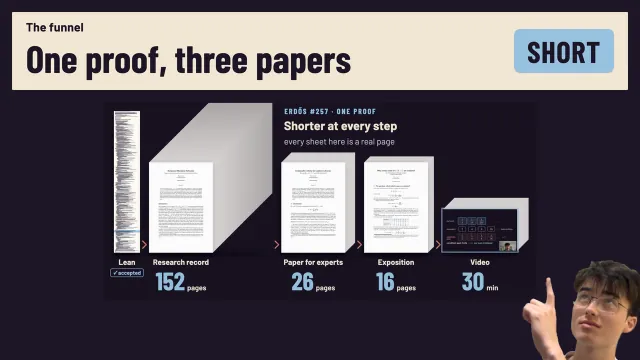
I start with one Lean proof. With AI, I turn it into a long record, a short paper, an explanation and a video. I used the same process for my research and the explanations here.
Lead papers
Finite-time blow-up for the Navier–Stokes and Euler equations, each read beside the authors’ own Lean.
Finite-Time Singularity Formation for the Three-Dimensional Euler Equations
Levent Alpöge, Tristan Buckmaster and Matei P. Coiculescu
The authors construct smooth periodic initial data for the three-dimensional incompressible Euler equations whose solution blows up in finite time, with the velocity bounded and the vorticity at the origin tending to infinity.
How each entry is labelled
Who gets credit
- Anthropic
- OpenAI
- Google DeepMind
- Academic authors or open-source projects
- The Lean community
- My research
What you can open
- Author’s paper or Authors’ paper
- the original text with links to Lean and reading notes
- Adapted edition
- a version I adapted with AI assistance. Every change is marked
- Original PDF
- the source file on its own
- Companion account
- an explanation I wrote with AI about someone else’s result
Other researchers’ papers
Read the authors’ text alongside the linked Lean.
The Parisi formula
Michel Talagrand
Talagrand proves Parisi’s variational formula for the limiting free energy of a class of mean-field spin glass models. The linked Lean proof treats the Sherrington–Kirkpatrick case with exact quadratic covariance.
Discovering formally verified quantum programs with AI
Sergey Shirobokov, Ben Jaderberg, Katerina Hristova and 22 others
The paper describes five quantum algorithms. The linked Lean statements cover their correctness, error and resource bounds.
Contextual Embeddings: Implementing Bound Variables Through Instance Resolution
Samantha Frohlich, Jessica Foster, G. A. Kavvos and Meng Wang
The authors use instance resolution to define a context-directed isomorphism between a higher-order interface for bound variables and a first-order representation. They prove the round trip in Lean.
The SMT-LIB Standard: Version 2.7
Clark Barrett, Pascal Fontaine and Cesare Tinelli
The reference standard for SMT-LIB 2.7, read beside BSmtLib, a Lean formalisation of its lexicon, grammar and parser.
Gauge theory: Physlib’s API map
The Physlib contributors
Physlib’s own map of its gauge theory formalisation, read beside the Lean files it cites.
My explanations of other people’s results
I wrote these explanations with AI. Where I include the original paper or the formaliser’s guide, I list it first.
Amireddy, Behera, Srinivasan, Sudan and Willumsgaard give an algebraic proof of the PCP theorem. Every language in NP has a polynomial-time verifier with logarithmic randomness, a constant number of proof-bit queries, perfect completeness and soundness error at most one half.
For every power below four there is a total Boolean function whose randomized query complexity exceeds that power of its quantum query complexity, and four is the best possible exponent. I include three accounts of OpenAI’s proof, with links from the text to Lean. The Lean proof of the optimal exponent has no hypothesis.
A minimising Parisi order parameter of the Sherrington–Kirkpatrick spin glass has no gaps: it increases across every interval in [0, 1), and its derivative is positive between 0 and 1.
The coupled spring potential U(x₀, x₁) = x₀² + x₀x₁ + x₁² has a local minimum at the origin, proved in PhyslibAlpha by a general second-derivative test.
My research
I worked on eight of Paul Erdős’s problems with AI agents. For each problem there’s a short paper and a longer record, with Lean proofs of selected statements. You can also read #257 alongside its Lean here. The counterexample for #1041 refutes one formal statement. The other seven problems remain open. No independent mathematician has reviewed these papers.
I prove that the sum of 1/(bᵃ − 1) over an infinite set A is irrational for every integer base b ≥ 2 when A satisfies a weighted summability condition, has a summable divisor cover, or lies in a union of one set of each kind. Erdős’s question for every infinite A remains open.
I use ani’s degree-seven polynomial to refute the exact path-length statement of #1041 in Google DeepMind’s Formal Conjectures. The Lean checks cover the counterexample and the positive trinomial and sharp collinear families. Review of how the formal statement matches Erdős’s 1958 wording is still pending.
I prove that a strictly increasing integer sequence with a_n²/a_(n+1) = 1 + 3/n + o(n⁻³) has an irrational sum of reciprocals. I also prove the result for every nonintegral regular rate above one. Lean checks both results. The unrestricted Sylvester-tail question remains open.
I classify the base-two totient-residue series for every positive modulus, with checks in Lean. I also give the exact rank kᵉ+1 of the totient kernel at every base. The original series with unreduced totients remains open.
I prove irrationality in Zudilin’s rational-base contour region, with exact Hankel orders and Lean checks. Base 3/2 and the claim for every rational base remain open.
I use a cited Hecke–Mahler theorem to prove that both two-prime running-LCM sums are transcendental. Lean checks the formulas and the conditional transfer. The three-prime irrationality question remains open.
If S = ∑ 1/(n! − 1) were a fraction, its denominator would not divide 299999! and would exceed 10¹²⁰³⁸. I prove a 3/2 growth exponent for the common denominator in Lean. Irrationality itself is still unproved.
I give a synthetic prime-gap countermodel checked in Lean and a sparse-perturbation obstruction. They rule out some methods of proof. The question about actual prime gaps remains open.
I connect the eight Erdős problems in this paper. I give ordinary proofs of the main theorems and use Lean to check the ingredients named in the paper.
I used AI to add links to Lean, short titles, comparisons and reading notes. The authors and other mathematicians have not reviewed these additions.